
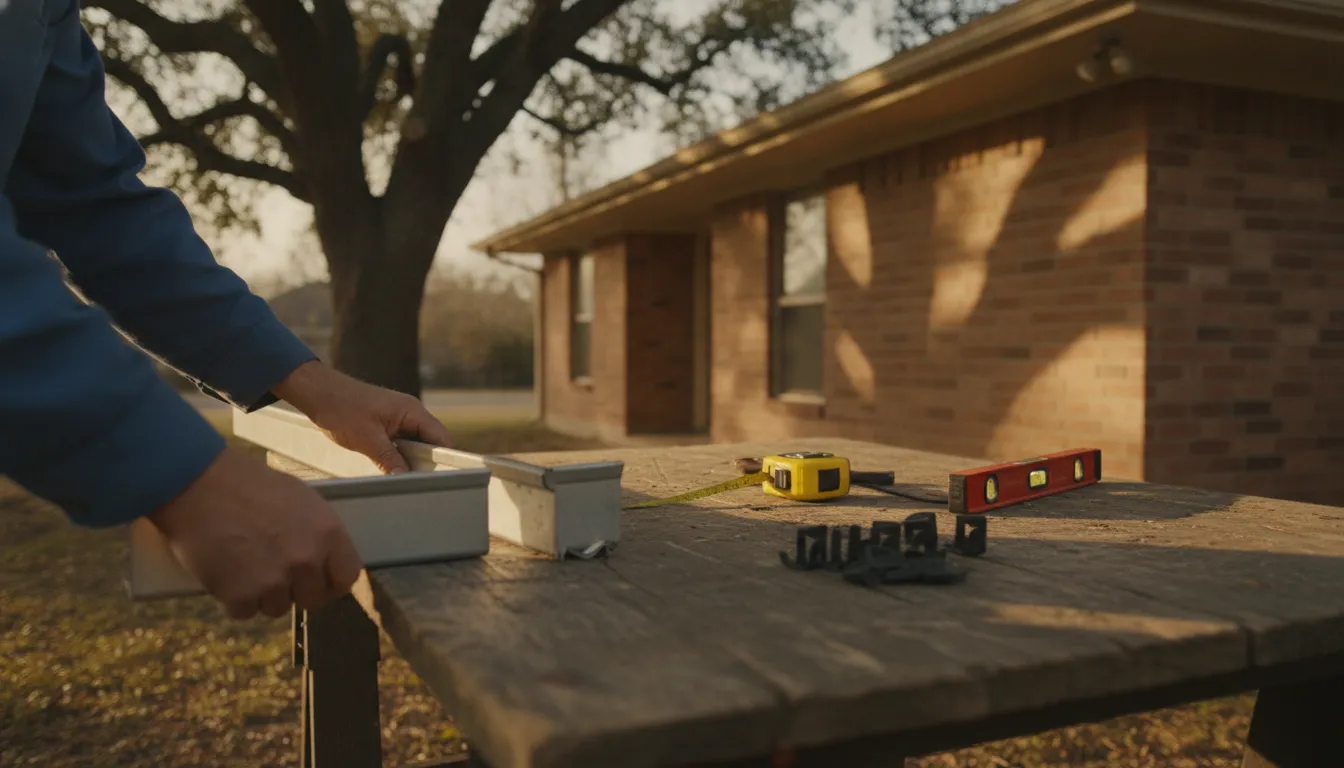
Do it yourself gutter installation looks straightforward in a hardware-store aisle. A sectional kit, a ladder, and a weekend can feel like enough. On a Central Texas roof, the hard part is not hanging a piece of metal. It is sending water to the right outlet, at the right slope, without tearing the board behind it.
This guide is for homeowners who want an honest look at that job before they buy a kit. It covers the plan, the tools, the alignment, and the water-flow mistakes that turn a weekend project into a leak. It is not a product ranking, a price sheet, or a walkthrough of a professional forming machine. If the house is in Austin, Leander, or Cedar Park, the safer finish is often a custom-fit system from professional Austin installers who form each run on site.
Need a second opinion before you buy a kit? TX Gutter Solutions is a family-owned, veteran-led company serving Austin and nearby Central Texas. Request a free, no-obligation estimate.
What does do it yourself gutter installation actually include
A store kit is sectional. Each length joins the next with a connector, and every joint is a place water can leave the trough. That is a different job from the seamless runs TX Gutter Solutions custom-forms on site for Austin homes, with no leak-prone joints along the eave.
A workable DIY plan still has to cover the whole roof edge, not one easy side. Before any hanger goes up, write down four things:
- Every eave that sheds water, including short returns over a porch or garage.
- Where each outlet can drop without soaking a walkway, a bed, or the foundation.
- Whether the fascia board is solid enough to hold screws.
- How you will get off the ladder if a section starts to twist.
Austin sits on the Blackland Prairie. Expansive clay swells when it rains and shrinks in summer heat. Water that dumps at the foundation is not a small cosmetic miss. The Austin gutter page explains why that soil movement is one reason a pitched, seamless system matters on homes from older bungalows to newer builds in Southwest Austin.
Sectional kits can still be the right experiment on a small shed or a low, simple eave you can reach safely. They are a weak match for a full house with inside corners, a valley that dumps hard, or a second story. Our comparison of seamless and sectional installation covers joints and repair in more depth. This page stays on the decision to try the work yourself.
Count the pieces before you leave the store. A straight run needs trough, hangers, end caps, and one outlet. A real house adds inside and outside corners, downspout elbows, and a short return you only notice from the yard. Missing one corner means a second trip, or a joint you invent on the ladder. Neither is a good plan.
Plan the roof edge before you buy a kit
Most failed DIY jobs start at the store, not on the ladder. People buy one length of gutter, a bag of hangers, and two downspouts, then discover a corner, a short return, or an outlet that the sketch never showed.
Walk the house on the ground first. Note each roof plane and where water already stains the soil. A valley that concentrates flow needs an outlet nearby, not a long run that hopes the water will make it. If you want a ground-level measuring method for a replacement quote, use our gutter measuring guide. Do not treat that worksheet as permission to climb.
Then look at what the kit will not decide for you:
- Mark every corner, end cap, and outlet on a simple sketch.
- Decide which way each run slopes, and which outlet it feeds.
- Check that the outlet lands where an extension can carry water away.
- Confirm the fascia is sound before you buy hangers for it.
- Stop if any eave needs a ladder you cannot move with one free hand.
TX Gutter Solutions starts a professional job with a consultation and an assessment, then installation. That order matters. A kit skips the assessment and leaves you to discover a soft fascia board after the first screws pull.
Color and metal choice are real, but they are not the first decision. The services page notes that seamless gutters are commonly aluminum, copper, or steel, chosen for durability and corrosion resistance. A DIY kit is usually one profile in a short color list. Matching trim on a brick Austin house is harder once the pieces are already cut.
Sketch in the shade, not on the driveway in July. Mark north so you remember which eave takes the afternoon storm. Write the outlet side on each line. A sketch you can hand to someone else is the whole point. If you cannot explain it on paper, you will not explain it from a ladder.
Tools, slope, and the mistakes that leak
A level, a tape, tin snips, a drill, sealant, hangers, and a sturdy ladder are the usual kit. The tool that decides whether the gutter works is the slope, not the snips.
Water in a gutter should move toward an outlet. A dead-level trough looks neat and holds water, leaves, and mosquito habitat. A slope that runs the wrong way dumps at the high corner and stains the fascia. A slope that is too steep can look crooked and still overshoot a small outlet in a hard Central Texas downpour.
Set the high point first, away from the outlet, and drop slightly toward the downspout. Check the drop with a level before you hang the whole run. Recheck after the joints are sealed, because a connector can lift one end. If you cannot see a consistent fall from the ground after a hose test, the run is not finished.
Hidden hangers need solid wood behind them. Spacing them too far apart lets the trough sag between screws, and a sag becomes a pond. Our note on choosing gutter hangers is about replacement hardware, not a DIY ranking. The same idea still applies. The hanger is only as good as the board it bites.
Sealant is the other quiet failure. Sectional joints move with heat. A bead that looks closed on a cool morning can open after a week of sun. Seamless installation avoids that row of joints by forming the run in one piece. That is the main reason a kit and a custom-formed system do not age the same way.
Do the hose test the same day, while the ladder is still out. Run water at the high end. Watch the front lip, every joint, and the outlet. Standing water after you shut the hose off means the slope is wrong. A drip at a connector means the joint is not seated. Fix both before you put the tools away. A storm will not be gentler than a garden hose.
| DIY step. | What has to be true. | What usually goes wrong. |
|---|---|---|
| Sketch the eaves. | Every run, corner, and outlet is on paper. | A porch return or valley is missing from the kit. |
| Set the slope. | Each run falls toward its own outlet. | A level trough holds water, or the fall goes uphill. |
| Fasten hangers. | Screws hit solid fascia, spaced to prevent sag. | Soft wood or wide gaps let the gutter pull away. |
| Join sections. | Connectors are seated and sealed. | Heat opens a joint and the leak shows up inside. |
| Place outlets. | Downspouts land where water can leave the house. | Discharge hits a walk, a bed, or the foundation. |
| Hose test. | Water reaches the outlet and does not stand. | The test is skipped and the first storm finds the pond. |
Where water has to go after it leaves the gutter
A gutter that catches rain and a downspout that drops it at the slab are only half a system. Austin clay and spring storms make the second half matter. The Austin page calls out violent spring storms, often in May, as one reason gutters are essential rather than optional.
Stand at each planned outlet and ask where the water goes next. A splash on mulch next to the foundation is not away. An outlet over a walkway is a slip hazard. An outlet aimed at a neighbor's bed will become a conversation you did not want.
Extensions and buried lines are separate work. Do not invent a trench plan on install day. If the house already has underground drainage, tying into it without knowing the pipe size and slope can back water up into the downspout. Keep this article on the gutter run itself, and treat drainage changes as their own decision.
Circle C, Mueller, Tarrytown, Westlake, Barton Hills, and Steiner Ranch are on the Austin service page because the roof shapes differ. The water rule does not change. Older bungalows and new Southwest Austin builds both need the outlet past the foundation line. The path to get there is what changes.
Hose-test before you call the job done. Run water at the high end of each run. You want a steady move toward the outlet, no spill over the front lip, and no drip at the joints. If water stands more than a moment after you stop the hose, fix the slope before the next storm does it for you.
Look at the soil after a normal rain, not only during the hose test. A dark fan against the slab means the outlet is still too close. A washed groove in the mulch means the same thing. Move the discharge farther out, or stop and ask for help, before you call the trough a success.
Safety and fascia limits that should stop the job
Gutter work fails in two expensive ways: a fall, and a gutter that lets go of the house. Both are reasons to stop, not to push through a Saturday.
Stay off the roof. Work from a ladder you can set on firm, level ground, and keep your belt buckle between the rails. Do not lean out to reach a corner. Move the ladder. A second person on the ground is not optional once a section is longer than you can balance with one hand.
NIOSH lists overreaching, carrying objects, and a ladder that is too short among the common causes of ladder falls, and it tells users to keep three points of contact. The same page says to stay at least ten feet from power lines and to set the ladder on a level, supportive surface. Read the NIOSH ladder safety notes before you treat a store ladder as enough.
Two-story eaves, steep pitches, and tight side yards change the job. Our planning notes for two-story gutter installation cover access questions that a single store ladder does not answer. If you cannot keep three points of contact while the section is in your hands, that eave is not a DIY eave.
Fascia is the other stop sign. Gutters hang from that board. If it is soft, cracked, or stained from an old overflow, new screws will not hold. Repair comes before new hangers. The guide to fascia repair before gutter installation explains why the order matters. Painting over the stain and hoping is how a new gutter sags in a season. Stains on the soffit are a related warning, covered in our soffit and fascia water damage signs.
Power lines near the eave, a metal roof you have not walked, and any ladder set on wet clay are also stops. TX Gutter Solutions crews work from Hill Country rooflines to flat modern facades because access is part of the trade. It should not be your first afternoon on a ladder.
When do it yourself gutter installation should stop
DIY is reasonable on a low eave with solid fascia and a simple straight run. You also need to hose-test it the same day. It stops being reasonable when any of the following is true:
- The run needs inside corners, a valley outlet, or more than one slope direction.
- You want a seamless piece instead of a joint every few feet.
- The fascia is stained, soft, or already pulling nails.
- The eave is two stories, steep, or boxed in by a deck or fence.
- You cannot explain where each downspout will discharge.
That is the point where professional Austin installers are the better path. TX Gutter Solutions custom-forms every seamless run on site. The long edge has no seam to leak. Crews color-match the trim and serve Austin plus nearby cities, including Leander and Cedar Park. The same team handles repair, cleaning, and leaf protection when the system needs more than a new trough.
The company is locally owned, licensed, and insured, and the public site describes the team as family-owned and veteran-led. The services page offers a limited warranty that covers materials and workmanship, without stating a length. Ask what that warranty covers for your home when you book. Do not treat a blog as the warranty certificate.
This article is not a cost guide, and it does not quote a price. For what changes a quote, use the gutter installation cost calculator and the cost of seamless gutters guide. A kit that leaks at three joints is rarely the cheaper outcome once fascia repair and water at the slab are in the picture.
You do not need a full installation tutorial to make the call. If the sketch has a corner you dread, or a ladder move you keep postponing, that is the answer. Request a free, no-obligation estimate and let a crew assess the fascia, the slope, and the outlets before you buy parts you may return.
What to hand off if you stop halfway
Stopping is a good outcome. A half-hung sectional run is easier to finish, or remove, when the next person can see what you already decided.
Leave a one-page note with the house. Mark which runs you consider done, which joints you sealed, and which outlets you do not trust. Photograph the fascia where screws felt soft. Measure nothing from the roof. If a section is loose, take it down rather than leaving it on two hangers for a storm.
A professional assessment still includes the parts you skipped. On an Austin job, the crew looks at roof edges that were hard to reach. They confirm the slope toward each outlet. They also plan downspouts that carry water off the foundation. It can also include cleaning and guards if oak or pecan debris is already part of the problem. Those are separate services, listed on the Austin page, not automatic add-ons.
Timing and permits are also separate questions. Our guides on how long gutter installation takes and Texas gutter permits answer those. Do not assume a DIY Saturday and a crewed install take the same hours, or that your city treats them the same. The services page says a typical install runs from a few hours to a full day, depending on the house. Your Saturday may not match that.
If you want a plain description of what a crewed Austin day looks like, read what to expect from gutter installation in Austin. That page owns the install-day story. This one is only about the decision to attempt the work yourself.
Bring the sketch to the estimate. A clear drawing of corners and outlets saves a return visit and shows you already know where the water misbehaves. The crew can confirm or correct it. Either way, you are no longer guessing from the aisle.
A simple way to decide this weekend
Put the kit back on the list until you can answer yes to all of these:
- Every eave on the sketch is one you can reach without leaning.
- You can point to the outlet for each run and the spot water will land.
- The fascia is solid where hangers would go.
- You accept sectional joints, and you will hose-test them.
- A second person can be there while sections are in the air.
If any line is a no, do it yourself gutter installation is the wrong tool for that house. Spend the weekend on the sketch instead of the ladder. Then ask for the free estimate and compare a custom-formed run with the kit in your cart.
Homeowners in Leander and Cedar Park can start from the same company. The Leander gutter service and Cedar Park gutter service pages cover those cities, and Austin remains the page this topic was built to support. The work is still local: on-site forming, a real look at the fascia, and a downspout plan that respects the soil.
There is no prize for finishing a leak. A gutter that holds water, pulls from the board, or dumps on the slab did not save the weekend. A clear stop, and a crew that installs for a living, protects the house you were trying to protect.
Use a short checklist if the decision still feels fuzzy. Walk one eave. Name its outlet. Press the fascia with a screwdriver from the ladder only if you can do it without leaning. If any of those three fails, the weekend project is the sketch, not the kit. That is a complete decision, not a delay.
Get a free estimate before you buy a kit. A family-owned, veteran-led crew can check the fascia, the slope, and the outlets on your Austin home.
Parts a kit still leaves you to choose
Even a simple sectional run is a parts list, not a single box. End caps, corners, outlets, elbows, and hangers all have to match the same profile. Mix two brands and the joint that looked fine in the aisle will not seat on the eave.
Our overview of gutter parts and accessories is the place to see what a full system includes. Use it as a shopping check, not as a reason to start. If the list is longer than the straight run you pictured, that is useful information. It means the house is not the shed you had in mind.
Downspout elbows are the piece people forget. One elbow at the outlet and one at the bottom still may not clear a shrub or a walk. Extra elbows add joints, and every joint is another drip. Plan the drop on the ground, with the downspout in your hands, before you cut the outlet hole.
Hanger style matters as much as hanger count. A spike driven into soft fascia is not the same as a screw that bites solid wood. If the board flexes when you press it, stop buying hangers and look at repair first. Our note on when to replace fascia before gutters is the neighbor to this decision. Do not hang new metal on a board that is already done.
Keep the receipt and the leftover parts together. A returned corner is cheaper than a corner you force into place. If the return window will close before you can hose-test, you bought too early. Wait until the sketch, the fascia, and the outlet plan all say yes.
After the first storm, not only on install day
A hose test is the start. The first real rain is the audit. Walk the house while it is still raining, from the ground, and watch three things: the front lip, the joints, and the soil at each outlet.
Water sheeting over the front lip means the run is over capacity, clogged, or pitched the wrong way. A bead at a connector means the seal moved. A fan of wet soil at the slab means the downspout stopped too soon. None of those need a roof visit to see. They do need a decision about whether you will climb again.
If you would not get back on the ladder to fix what you see, the install was past your limit the first time. That is not a failure of nerve. It is the information the weekend was supposed to produce. Call for an assessment while the stains are fresh, and bring the photos.
Oak and pecan drop debris that a brand-new trough will collect before summer is over. Guards are a separate choice, not a patch for a bad slope. If leaves are already the reason you wanted new gutters, say so on the estimate. Cleaning and leaf protection are on the Austin service list. They are not included just because someone hangs a trough.
A seasonal look from the ground belongs on your calendar either way. Our gutter inspection checklist is a short pass you can do without a kit. Use it after storms. If the same joint weeps twice, stop sealing it and replace the run, or hand it off.
Frequently asked questions
Can I install gutters myself on a single-story house?
Sometimes, on a low, straight eave with solid fascia and a helper on the ground. Corners, valleys, and any run you cannot hose-test the same day are where do it yourself gutter installation usually fails. If you have to lean past the ladder rails, stop.
Do I need seamless gutters, or will a sectional kit work?
A sectional kit can move water on a small, simple edge if every joint stays sealed and the slope is real. Seamless gutters are formed in one piece on site, so the long run has no connector to open in the heat. TX Gutter Solutions custom-forms those runs for Austin homes. For the full comparison, use the seamless versus sectional guide rather than a kit label.
What slope should a DIY gutter have?
The trough should fall toward its outlet enough that a hose test shows steady movement and no standing water. Dead level looks tidy and ponds. The wrong direction spills at the high corner. Recheck the fall after joints are sealed, because connectors can lift an end.
Where should I look for installation cost?
This page does not quote a price. Use the gutter installation cost calculator and the cost of seamless gutters guide linked above. Those pages own the quote factors. A kit sticker still leaves out bad joints, fascia repair, and water at the foundation.
Who should I contact if I start the job and need to stop?
Contact TX Gutter Solutions and request a free, no-obligation estimate. Say which runs are up, which joints you sealed, and where the fascia felt soft. A family-owned, veteran-led crew can assess the Austin house and finish it as a custom-fit system instead of building on a leak.
Get a free Austin gutter estimate
If the ladder plan or the outlet plan is shaky, leave the kit in the cart. TX Gutter Solutions will look at the roofline, the fascia, and where the water should go, then give you a free, no-obligation estimate.
Request your free estimate. We serve Austin and the surrounding area, including Leander and Cedar Park, with seamless installation, repair, cleaning, and leaf protection.