
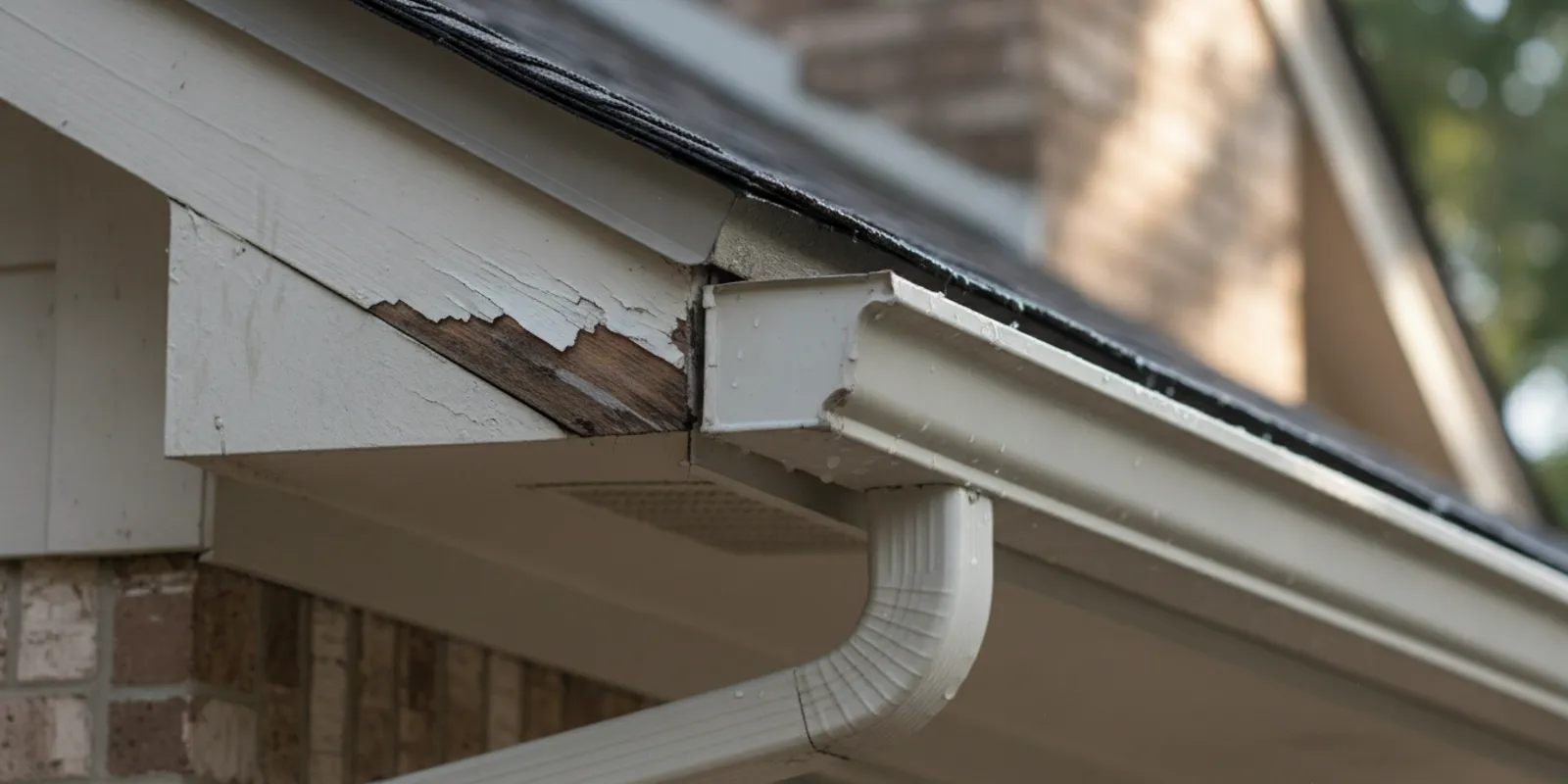
Soffit and fascia water damage signs can be easy to miss from the ground, but they may point to a recurring moisture problem at the roof edge. Peeling paint, soft wood, staining, or a gutter pulling away deserve a closer look. Here is how to inspect the area, consider possible causes, and decide what to do next without assuming that every mark means major damage.
What do fascia and soffit do at the roof edge?
The fascia is the vertical board along the roof edge. Gutters are commonly attached to it. The soffit is the underside of the eave, between the exterior wall and the roof edge. Depending on the home's design, soffit panels may also include vents that support attic airflow.
These components sit where roof runoff, wind-driven rain, and outdoor air meet. A stain or damaged panel can have more than one explanation, so look for patterns and related symptoms rather than making a diagnosis from one spot. If a gutter is involved, the gutter services overview explains the types of work available.
What are common soffit and fascia water damage signs?
Check the eaves from the ground first. Use binoculars or take a zoomed photo if you need a closer view. Avoid climbing a ladder to inspect a roof edge unless you are equipped and comfortable working safely.
- Peeling, bubbling, or blistered paint: Moisture can loosen paint, especially where the same area repeatedly gets wet. Peeling may also result from age or a poor prior paint job, so note whether it is localized below a roof edge, gutter, or joint.
- Dark streaks or water marks: Staining on the fascia or soffit may show where water has run or splashed. Look for a trail above or beside it, such as a roof valley, gutter seam, or downspout connection.
- Warped, swollen, or sagging material: Wood and some panel materials can change shape when exposed to moisture. A panel that is no longer flat or sits unevenly may need closer inspection.
- Soft, crumbly, or rotted wood: This is more concerning than a surface stain. Do not press hard or probe from a ladder; note the location and have the area assessed.
- Loose or separated panels: A gap at the soffit, fascia joint, or roof edge can let water or pests enter. A loose panel can also be caused by failed fasteners or wind, not only water.
- Gutter pulling away from the fascia: A sagging or detached section may indicate a support problem, excess debris, water load, or deterioration behind the attachment points.
- Water marks inside the attic near the eaves: If accessible, check for damp insulation, staining, or a musty smell near the roof edge. Do not enter an unsafe or poorly ventilated attic.
One clue by itself is not proof of a leak or structural issue. Several signs clustered in the same area, especially if they recur after rain, make it more important to identify the water path. Notice whether staining is above the gutter, directly behind it, or on the underside of the eave. A photo that shows the full roof edge and a second close-up can preserve this context for whoever evaluates it.
How can you inspect the eaves without creating a hazard?
A short, repeatable inspection can help you explain the problem accurately. Choose a dry day and stay on the ground where possible.
- Walk the perimeter. Look along each roof edge for stains, uneven panels, open joints, or gutter sections that appear tilted or separated.
- Compare similar areas. Note whether the damage is limited to one corner, below a roof valley, or spread along a whole run. A comparison helps distinguish a local issue from a widespread one.
- Check the gutter line. Look for visible sagging, overflow marks, debris at the edge, disconnected downspouts, and water spilling behind or over the gutter. Do not reach over the roof or remove a gutter section.
- Observe during rain only from a safe place. Watch whether water flows through the gutter and exits the downspout, or whether it sheets over the edge or runs behind the gutter. Never inspect during lightning or strong winds.
- Take dated photos. Photograph the full side of the home and then the affected area. Repeat from the same spot after a later rain if you need to see whether the mark changes.
- Record related observations. Note when you first saw the damage, whether it changes after rain, and whether there are interior stains, musty odors, or drainage problems below the downspout.
Keep off wet roofs and do not lean a ladder against a gutter. If material is loose, the area is high, or you see extensive decay, leave close inspection to a qualified professional. Do not try to lift a gutter to look behind it: the fasteners may be compromised, and moving it could make a loose section less stable. A ground-level record is usually enough to start a useful conversation.
What can cause water damage to fascia or soffit?
Water at the eaves may come from several directions. The pattern can offer clues, but tracing the source may require inspecting the roof edge and drainage system.
- Overflowing or blocked gutters: Leaves and other debris can restrict flow. During rainfall, water may spill over the front or back of a gutter and repeatedly wet the fascia or soffit.
- Gutter slope, attachment, or capacity issues: A sagging section, loose fasteners, or a poorly directed outlet can leave water standing or send it where it should not go.
- Roof runoff that misses the gutter: Water can travel over or behind a gutter if the roof edge, drip edge, or gutter position is not directing it into the channel.
- Roofing or flashing leaks: A leak higher on the roof may travel before it becomes visible at the eave. A gutter repair alone will not address a roof leak.
- Wind-driven rain: Strong wind can push rain toward openings at the eaves. The U.S. Department of Energy's Guide to Durable Attics identifies warped or rotted soffit panels and fascia as possible signs of water intrusion.
- Condensation or ventilation concerns: Moisture in an attic may have causes unrelated to rain entry. If staining appears indoors or across broad areas, consider a qualified roofing or building professional to assess the full assembly.
- Downspout discharge near the home: A gutter can collect water correctly yet discharge it beside the wall or foundation. Check whether the outlet carries water away rather than depositing it directly at the base of the home.
TX Gutter Solutions focuses on gutters and drainage, not roof or structural repairs. If the likely source appears to be roofing, flashing, or a broader building issue, a roofer or other qualified professional may be the right next call.
How can the location and pattern narrow down the likely source?
Location does not prove a cause, but it helps organize the next inspection. A single wet-looking patch near a gutter end suggests a different route from staining that runs along a long section of eave or appears inside the attic. Describe the pattern rather than deciding on a repair before the source is known.
| Observed pattern | Possible area to check | Useful next observation |
|---|---|---|
| Staining directly below a gutter seam or end | Gutter joint, end cap, or nearby drainage path | From the ground, note whether water appears there during rain. |
| Water streaks behind the gutter | Roof edge, drip edge, or gutter position | Look for a consistent trail after rain without reaching over the roof. |
| Damage concentrated below a roof valley | Heavy runoff at that roof section or a nearby gutter run | Compare the valley area with adjoining eaves during safe observation. |
| Broad attic dampness or interior staining | Roofing, flashing, ventilation, or another building source | Record where it appears and seek an appropriate building professional. |
| Gutter sag with damaged fascia near its fasteners | Attachment points and the condition of supporting material | Do not pull or push the gutter; arrange an assessment of the assembly. |
These are starting points, not a diagnostic chart. Water can travel along framing or behind exterior finishes before becoming visible, and more than one issue can be present. If a stain appears after wind-driven rain but not ordinary showers, share that timing; if it appears after every rainfall, record that too. The difference may help a professional decide what parts of the roof edge and drainage route to examine.
When should you arrange a professional inspection?
Consider getting help when damage keeps returning, wood feels or appears deteriorated, a gutter is pulling away, water is entering the attic, or you cannot identify where runoff goes. A professional can evaluate the gutter and visible drainage components and explain whether the concern appears to be within that scope.
It is useful to share photos, the location of the affected eave, and what you observed during rain. Ask what the inspection covers, whether the suspected source is within the contractor's services, and whether another trade should evaluate the roof or damaged wood. A clear scope helps avoid treating a symptom while leaving the water source in place.
For homes in the service area, review gutter installation and repair information for Austin, or see the service-area list to find the most relevant location page. The about page shares more about the family-owned, veteran-led company and its home-protection perspective.
What should you do after finding a water stain?
Start with documentation rather than covering the mark immediately. Photograph the spot, check for nearby gutter or downspout issues from the ground, and watch the area during safe weather. If the surface is dry and sound and the source has been corrected, a homeowner may choose to handle cosmetic maintenance; if the material is soft, warped, or repeatedly wet, identify and address the cause before repainting or replacing panels.
Do not seal over an active leak or close a vent opening without understanding its function. Blocking soffit ventilation can create a different building concern. If water is entering the attic, damage is extensive, or you are uncertain whether the issue is roof-related, seek an appropriate building professional.
How can you prepare for an assessment?
Before contacting a contractor, gather information that makes the first discussion more specific. You do not need to identify the fault yourself. A concise description helps distinguish a gutter concern from a roof or material concern and can prevent an unnecessary assumption about what work is required.
- Mark the location: Identify the side of the home and whether the spot is near a corner, valley, downspout, or long straight gutter run.
- Describe the timeline: Note when you first noticed it and whether it changes after rain, wind, or a period of dry weather.
- Include context in photographs: Take one wide view and one closer view from the ground. Do not climb or remove panels to get a better image.
- List connected observations: Mention overflow, standing water in a visible gutter, a detached downspout, interior marks, or damp attic material if safely observed.
- Ask about scope: Confirm whether the assessment covers gutters and drainage, and ask who should inspect if signs point to roofing, flashing, ventilation, or damaged wood.
Keep records together rather than relying on memory. If the stain changes, add a dated photo from roughly the same viewpoint. This can show whether the mark is stable, growing, or recurring, while avoiding an unsafe close inspection.
How do you distinguish surface wear from ongoing moisture?
A faded finish does not automatically mean water is entering the assembly. Paint can age unevenly, and sunlight can weather one side of a house faster than another. The practical question is whether the surface shows evidence of repeated wetting, whether the underlying material is still sound, and whether the condition changes over time.
Compare the affected section with nearby areas of similar exposure. If all fascia boards on a sunny side have similar fading but remain flat and intact, age or exposure may be more plausible than a localized leak. If one small area below a gutter outlet is bubbling while the neighboring paint is sound, that contrast is worth recording. Neither pattern alone identifies the cause, but comparison makes the observation more useful.
Look for progression rather than relying on a single snapshot. A dated photo taken from the same place can reveal whether a stain is expanding, a panel is sagging further, or a paint blister is unchanged. Repeating the photo after a rainfall can help establish timing. Avoid scraping paint or pressing into wood to test it; those actions may damage the finish and do not reliably locate the source.
Interior clues also matter. A water mark on attic framing near the eave, damp insulation, or a musty odor deserves attention, particularly if the condition follows rain. But moisture can also come from condensation or another building issue. A qualified roofer or building professional can assess the roof and attic as a system instead of assuming the visible fascia is the origin.
What should you watch for during and after rainfall?
Observing water flow can clarify how the gutter system behaves without requiring a risky close inspection. Choose a safe spot indoors or under a covered area, and look only when conditions are calm. Do not stand beneath a damaged overhang or go outside during lightning, high winds, or other hazardous weather.
Watch a few different points rather than only the stained section. At a roof valley, a concentrated stream may enter the gutter quickly. At a long straight run, observe whether water travels toward an outlet or spills from one spot. At the downspout, check whether discharge reaches the intended outlet and whether water pools close to the wall. Record what happens and where rather than trying to estimate flow or diagnose the system.
After rainfall ends, look for fresh wet streaks, dripping that continues longer than expected, or water marks that appear behind the gutter. Take a photo when safe. If the same section overflows in ordinary rainfall, note it; if the issue appears only during a particular wind direction or especially intense shower, record that distinction too. Timing is helpful context, not proof of a single fault.
Do not pour water onto the roof to recreate a leak. Artificial testing can send water into openings in an uncontrolled way and may not reproduce the rain or wind conditions that caused the concern. Do not use a hose from a ladder or try to clear a blockage while water is running. If debris, a loose section, or a suspected leak cannot be assessed safely from the ground, leave the closer examination to a professional.
How do gutters, roof edges, and soffit vents relate?
The roof edge is an assembly of connected parts, not a single board. Roof covering directs water down the slope; edge details help guide it toward the gutter; the gutter carries runoff to an outlet; and the fascia provides a visible surface and may support gutter attachments. The soffit closes the underside of the eave and may contain ventilation openings. Water entering at one point can leave signs somewhere else, so a stain's location may not be the entry point.
For example, water that runs behind a gutter can wet the fascia repeatedly. A loose gutter may also move under load and expose gaps. A roof leak above the eave, however, can travel along framing and emerge at the soffit. Meanwhile, an attic moisture issue may affect the underside of the roof without any outside gutter overflow. These possibilities can look similar from the yard, which is why a careful description is better than assuming that a gutter replacement or a board repair will solve every case.
Soffit vents have a separate function from gutters. They are part of the building's ventilation design, and their location and opening should not be changed casually. Do not fill, caulk, paint over, or cover a vent just because a nearby panel looks stained. If rain appears to enter through an opening, a qualified professional should inspect both the water-management detail and the ventilation arrangement.
Where gutters and drainage are clearly involved, a provider can assess the visible collection and discharge path. TX Gutter Solutions offers gutter installation, repair, cleaning, and related services; roof covering, flashing, ventilation, and structural wood repairs may need a different trade. Starting with the right scope avoids asking a gutter crew to diagnose work outside its role.
What are sensible short-term steps while you arrange help?
If you see a stain but no active water entry, document it and watch for change. Keep the area around the home's exterior clear enough to notice runoff, and make sure stored items do not block access to the downspout outlet at ground level. These are observation steps, not a substitute for repairing a recurring source.
If water is actively entering an interior space, protect belongings only if you can do so safely. Avoid touching wet electrical fixtures or standing water near electrical equipment. Do not go into a wet attic, climb onto a roof, or attempt to remove loose fascia or soffit material. If the water is substantial or there is an immediate hazard, contact an appropriate emergency or building professional.
Do not apply caulk, roof cement, or paint as a quick cover-up when the source is uncertain. A patch can hide the evidence needed to trace the path and may trap moisture in some assemblies. Likewise, do not fasten a gutter back into soft or decayed wood without confirming the supporting material is sound. A repair that secures only the visible piece may not restore a safe attachment.
Keep the notes simple: location, date, weather conditions, visible gutter behavior, and any inside signs. Share this information when arranging an inspection. If you already know that the gutter is clogged or disconnected, say so, but avoid describing that as the confirmed cause of fascia damage unless it has been assessed.
What questions help you choose the right kind of assessment?
When you contact a service provider, start with the observation rather than a requested repair. For example: “There is a dark mark below the back gutter, and it looked wetter after last night's rain.” This gives the person taking the call a location and a timeline without presuming the cause. Add whether the gutter visibly overflows, whether the mark is inside or outside, and whether the problem repeats.
- What parts will you inspect? Clarify whether the visit covers gutters and downspouts, or whether roof edges and attic conditions are also within scope.
- What observations support the recommendation? Ask what was seen and how it relates to the proposed work. A useful explanation connects the visible symptom to the water route.
- Is another trade needed? If the suspected issue involves shingles, flashing, ventilation, or decayed structural wood, ask who is qualified to assess that part.
- What should remain untouched? If a panel or gutter is loose, ask whether to keep people away from that area until the next step.
- How will the water source be addressed? The question is not only how to repair the stained surface, but how to prevent the same wetting pattern from returning.
A good assessment should distinguish observed facts from possible explanations. It may not be possible to confirm a hidden water path from one exterior view, and a responsible recommendation can include the need for a roofer or other specialist. That is more useful than a confident conclusion based only on a stain.
How do repair decisions depend on the condition of the material?
The right next step depends on whether the material is merely discolored, has a damaged finish, has lost its shape, or no longer provides a sound attachment. A cosmetic surface issue after the source is resolved is different from wood that crumbles or a gutter that is detaching. Do not assume the same treatment fits every mark.
For stable material with a small area of finish wear, maintenance may eventually be straightforward once the source of moisture has been ruled out or corrected. For a panel that is swollen or loose, the underlying edge detail and fasteners should be considered. For deteriorated fascia near gutter hangers, the attachment itself may need attention before the gutter can be expected to remain secure. Any concealed damage should be assessed by someone qualified to open or repair that assembly.
Take care not to confuse the order of work. If water is still entering, repainting the fascia treats the appearance while the exposure continues. If the fascia is not sound, reattaching a gutter to the same weak point may not solve the support issue. Conversely, replacing boards without correcting a gutter overflow or roof-edge path may invite the problem to return. The sequence should follow the cause and the condition found on inspection.
When the concern is within gutter and drainage scope, a service provider can explain available options for the collection system. When the finding points to roof covering, flashing, ventilation, or structural repairs, another professional may need to lead. Ask for the boundary of the proposed work in plain language so you know which part is being addressed and what remains outside it.
How should you think about prevention after the source is addressed?
Once a water path has been corrected and any damaged material has been dealt with, periodic observation can help you notice a recurrence early. Include the eaves when looking over the exterior, especially after a storm or a change in how water exits a downspout. You do not need to inspect from a ladder to notice obvious changes in the gutter line or new staining.
Keep gutters and outlets clear enough to carry runoff, and pay attention to visible sagging, loose connections, or repeated overflow. Gutter cleaning and maintenance can be useful parts of a broader home-care routine, but the appropriate interval depends on the property, surrounding trees, and observed debris. Avoid treating a fixed calendar interval as universal when conditions vary.
Also keep drainage beyond the roof edge in view. A downspout that empties beside the home can concentrate water at the ground even when the gutter itself is working. Observe whether discharge is directed away from the immediate wall area and whether water is pooling. If the yard's grading or a drainage feature appears to be involved, consult a qualified drainage or landscape professional rather than assuming that the gutter alone controls the whole route.
For a home in Central Texas, pay attention to the way a system performs in the weather it actually encounters. Different roof shapes, tree coverage, and exposure can create different maintenance needs from one property to the next. The aim is not to predict a particular storm outcome; it is to notice recurring conditions and address the relevant water path before damage spreads.
How can you keep a useful record of the issue?
A simple record is often more useful than a long description based on memory. Use a note on your phone or a small home-maintenance log with the date, area of the house, weather, and observations. Keep each entry factual: “stain appeared wider after rain” is more useful than “gutter is definitely leaking” if the source has not been confirmed.
Photographs work best when they show both scale and location. Take a broad image that identifies the roof edge and nearby corner or downspout, then a closer image from the same safe position. Avoid digital zoom so extreme that the detail becomes unclear; if you use zoom, preserve the wider context in another frame. Do not include a person on a ladder or place yourself beneath a loose panel to get a better angle.
If you notice interior signs, record their position relative to the exterior. For instance, write whether the attic mark is near the eave above the stained fascia, or whether it appears in another part of the room. This does not establish a direct connection, but it helps an assessor compare observations. If conditions change, add a new dated image rather than replacing the original.
Share the record with the relevant professional and keep a copy after repairs. A later comparison can help determine whether the same signs have returned, whether a new location is affected, or whether the original mark remained stable. Documentation supports a focused conversation; it cannot replace a physical assessment where concealed parts may be involved.
How should homeowners in different service areas use this guidance?
The basic signs are similar across homes, but roof design, tree cover, exposure, and drainage layout affect what an inspection reveals. A one-story home with an easily visible eave may be simpler to observe from the ground than a home with tall walls, a steep roof, or limited access. In every case, keep the inspection within safe reach and leave elevated or unstable components to a professional.
TX Gutter Solutions serves Austin, San Antonio, Dallas-Fort Worth, and surrounding markets. If you are in Austin, the Austin gutter information offers a place to review local service details. Homeowners in other areas can check the service-area list rather than assuming coverage based on a nearby city name.
Service availability does not mean every visible problem is a gutter issue. A company focused on gutters can help evaluate gutter condition and drainage behavior, while a roofing professional may be better placed to inspect roof covering or flashing. If wood has deteriorated, a qualified contractor should determine whether the board or supporting assembly needs repair. Matching the concern to the right trade can save time and keep the scope clear.
For general background on the company and its approach, see the company information. When contacting any provider, include the location, photos, and timing of the water mark. A clear initial description helps determine whether an estimate or a different specialist is the appropriate next step.
Contact us to discuss your gutter concerns
Early attention can help you understand whether a mark is cosmetic or a sign of ongoing moisture, and what kind of professional assessment makes sense next.