
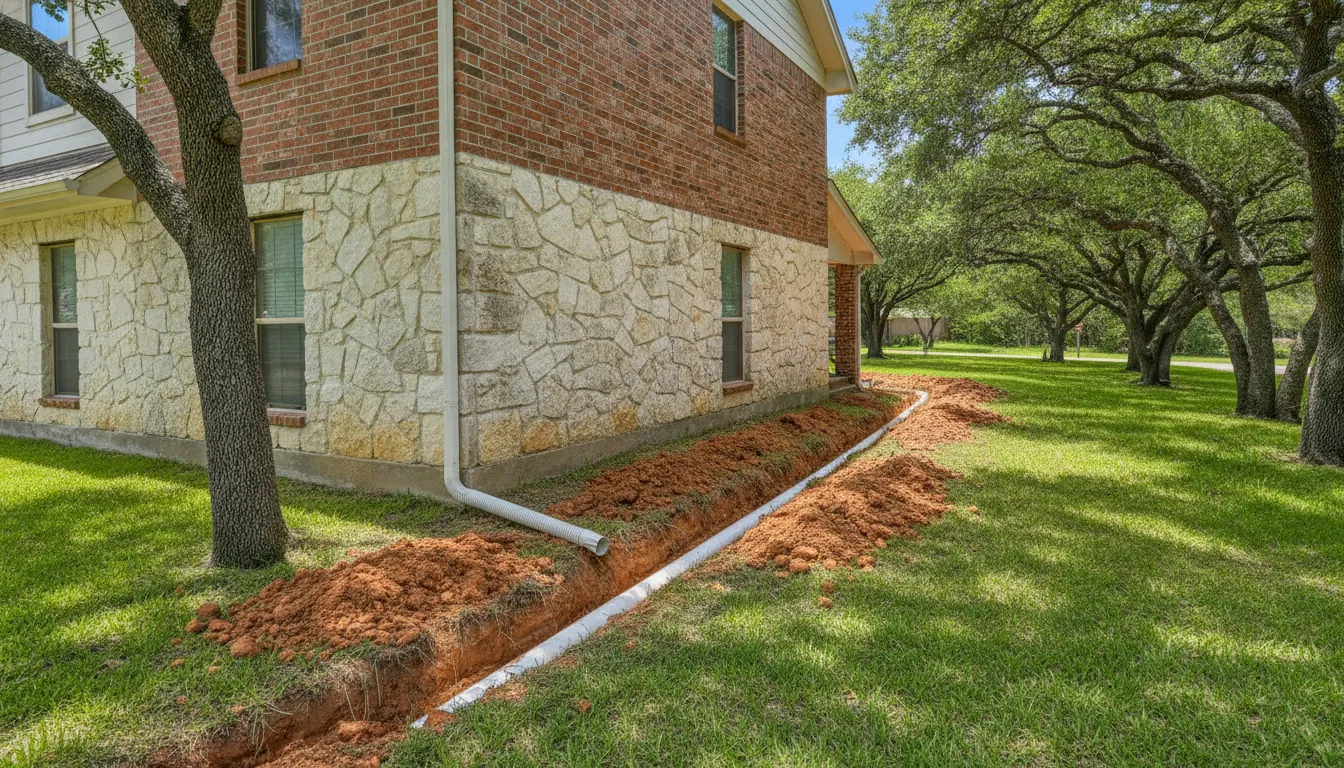
How deep to bury gutter drainage pipe depends on what sits above it, not on a single statewide number. Cover is the soil over the top of the pipe. A mower in an open lawn, foot traffic beside a walk, and a vehicle on a driveway each ask for a different amount. Digging deeper does not help if the pipe is flat, sags in the middle, or ends where the water has nowhere to go.
Most lawn runs need about 6 to 12 inches of cover. A line under a driveway usually needs 18 to 24 inches so it is not crushed. Engineer Fix treats those figures as practical ranges, not a code that applies to every Texas lot. The slope of the run still decides whether the pipe empties after the rain stops.
Request a free drainage estimate
What decides how deep to bury gutter drainage pipe?
Burial depth means the amount of soil cover over the top of the pipe, not simply how deep the trench is. That distinction matters because a deeper trench does not help if the pipe sits too low in one area, loses its intended slope, or ends where water cannot drain. The right amount of cover is a balance between protecting the pipe and preserving a path for water to leave the system.
Start with what will be above the line. For a pipe running through a lawn with no vehicle traffic, Engineer Fix describes 6 to 12 inches of cover as common industry practice for protecting against routine yard maintenance. A line under a driveway, sidewalk, or another loaded area generally needs more protection. The same guidance gives a range of 18 to 24 inches of cover in those locations to reduce the risk of crushing. These are practical ranges, not a universal code requirement or a promise that one depth fits every property.
The available slope is just as important. A pipe can have plenty of soil above it and still perform poorly if the grade creates a low spot. Water left sitting in a sag can freeze, collect sediment, or remain near the home instead of moving to a suitable outlet. The layout has to maintain a workable fall while avoiding conflicts with foundations, utilities, paving, tree roots, and other features on the property.
Central Texas freezes are shallow and less persistent than those in northern states. In this region, the usual goal is protecting the pipe and keeping it empty, not trying to outrun a deep frost line. That does not mean frost can be ignored: standing water in a poorly graded line can still freeze during a hard cold snap. Local soil, surface loads, drainage conditions, and the planned discharge point may all change the best cover depth.
Because those conditions vary, a drainage layout should be evaluated as part of the whole water-management system rather than by depth alone. TX Gutter Solutions provides gutter and drainage solutions designed to redirect runoff away from foundations and landscaping, with the property conditions guiding the recommendation.
How much cover does each part of the yard need?
There is no single answer to how deep to bury gutter drainage pipe across every yard. The right amount of soil above the pipe depends mainly on what will happen above it. A quiet lawn has different demands from a driveway that carries a vehicle's weight.
Think of cover as protection from routine maintenance, foot traffic, and crushing loads. The ranges below are practical guidance, not a substitute for checking the site, local requirements, and utility locations before digging.
| Location | Practical soil cover | Why it changes |
|---|---|---|
| Open lawn or bed with no traffic | 6 to 12 inches | Enough separation for routine yard care when there are no heavy surface loads. |
| Walkway or patio edge | Toward the deeper end of that range or a protected sleeve | People and furniture create point loads, especially near an edge or transition. |
| Driveway or vehicle path | 18 to 24 inches | Additional cover helps reduce the risk of the pipe being crushed by repeated vehicle loads. |
Engineer Fix gives the 6-to-12-inch range for areas without heavy foot or vehicle traffic and 18 to 24 inches beneath driveways, sidewalks, and other high-traffic areas. Those figures describe soil cover, meaning the soil measured from the finished surface down to the top of the pipe. They do not describe the total trench depth.
For example, a 4-inch pipe with 8 inches of cover needs a trench a bit deeper than 12 inches once bedding is added beneath the pipe. The exact depth also has to preserve the intended fall along the route, rather than creating a low spot where water can sit.
Pipe choice matters under the soil as well. Solid, smooth PVC, including Schedule 40 or SDR 35, holds its shape better than corrugated flex. Flexible corrugated pipe can collapse or deform, restricting flow and potentially dumping water near the foundation instead of carrying it away. For a site-specific assessment, a professional can account for surface loads, grade, soil conditions, and the route the water needs to follow.
Why slope matters more than extra depth?
When homeowners ask how deep to bury gutter drainage pipe, depth is only part of the answer. A trench can be deep and still drain poorly if the pipe is flat, rises along the route, or dips in the middle. Water follows the pipe's low points, so a consistent fall toward the outlet usually matters more than simply digging farther down.
As a practical guideline, plan for at least 1/8 inch of fall per foot. A 1/4-inch-per-foot slope moves water faster and leaves less sediment behind. For example, a 20-foot run at 1/4 inch per foot has 5 inches of total fall. Before any soil or other cover is added, the outlet end of that trench is 5 inches lower than the starting point. The route, outlet elevation, and existing grade still determine whether that slope is workable on a particular property. This general slope guidance is also discussed by Engineer Fix.
Extra depth cannot correct a belly in the line. A low spot holds water after the rain ends, and in a Central Texas hard freeze that trapped water can still expand and crack the pipe. Deep northern frost lines are not usually the local problem around Austin, but standing water in a sag is a problem in any climate. The trench needs a stable, continuous grade rather than isolated deep spots.
Austin-area soil adds another reason to watch the finished grade. Expansive clay swells when wet and shrinks during summer heat. As the soil moves around a backfilled trench, it can open or worsen a low spot, even when the original excavation was carefully shaped. Good bedding, thorough compaction, and checking the grade before covering help, but the right details depend on the soil, route, outlet, and surface use.
The guide to installing underground downspout drainage owns the step-by-step work. Use this section as a planning principle: choose a route that can maintain a steady fall, then select enough cover to protect the pipe from the conditions above it. A site-specific assessment is worthwhile when the yard is flat, the outlet is constrained, or the soil has already shifted.
What should you check before you dig to that depth?
Before choosing a burial depth, make sure the planned route can actually move water where you need it to go. A pipe that is deep enough but ends in a poor location can still leave saturated soil, erosion, or runoff near the foundation. Walk the route after a storm if possible, and look for low spots, gates, sidewalks, driveways, tree roots, and areas where water already collects.
Start with underground utility checks. Texas law requires homeowners to contact Texas 811 at least two business days before digging, even when the work is in their own yard. The service is free. Wait for the marking process to be completed before breaking ground, and keep your planned route visible so the markings can be compared with it.
Next, decide how the water will leave the line. A daylight outlet can work when the pipe can maintain a dependable fall to a suitable lower area. A pop-up emitter may be more practical when the outlet needs to stay near the surface, but it should remain above the surrounding grade so soil and mulch do not bury it. Either way, the discharge point needs room to release water without creating a new problem.
Check the direction of that discharge carefully. It should not send concentrated flow onto a neighbor's property, across a walkway, toward a driveway that drains back to the house, or against a slope that carries water toward the foundation. San Antonio's flash-flood conditions are one reason outlet capacity matters: a small, restricted exit can struggle when a short period of heavy rain sends more runoff through the system.
Finally, ask whether a buried line is the right tool. If a short extension is all you need to move water away from the wall, a surface option such as a splash block for a downspout may be simpler to inspect and maintain. If the entire yard holds water, one downspout pipe may not address the larger drainage pattern; use this yard drainage solutions guide to consider the broader issue. A French drain is a different system, and this French drain guide does not provide a price for the buried gutter line discussed here.
When the route, outlet, and surrounding grade are unclear, a site-specific assessment can help you avoid digging a line that has nowhere reliable to drain.
What are the signs the pipe is buried wrong?
A buried downspout line should move water away from the house without leaving obvious trouble along its route. After a rain, look for these warning signs:
- Water backs up into the downspout. This can point to a blocked line, but it can also mean the buried pipe does not have enough slope to carry water away. A low spot can hold water instead of allowing it to drain.
- A soggy stripe follows the trench. Persistent wet soil over the pipe may indicate a loose connection, a damaged section, or too little cover. It is a sign to inspect the route rather than assume the yard simply needs more time to dry.
- The pop-up emitter disappears under mulch. An emitter needs to remain visible and able to open when water reaches it. If mulch or soil has covered it, the outlet may be buried too deeply or the surrounding grade may have settled.
- Soil settles into a dip. A shallow trench that was not filled and supported well can sink over time. The resulting dip may change the pipe's slope, creating a place where water sits.
- The pipe is crushed where a vehicle crossed. A line with only lawn cover may not withstand vehicle traffic. Driveways and crossing points need enough cover and protection to resist crushing; a shallow run beneath a vehicle path is a reason to stop and reassess it.
These symptoms do not always mean the burial depth alone is the problem. The right cover and a consistent slope work together, and a buried line cannot fix a clogged gutter. If the gutter is packed with leaves or debris, read about why gutter cleaning matters before blaming the underground route.
Stop a do-it-yourself project and get another set of eyes when the route passes under a driveway, several downspouts are tied together, the lot is flat, or the property has a history of foundation movement. Those conditions make grading, flow, and settlement harder to judge from the surface. TX Gutter Solutions can look at the route during a free, no-obligation estimate and explain what the symptoms may indicate without pressure.
How do Central Texas soils change the cover you need?
The ranges above assume the soil stays put after you backfill. Around Austin, much of the ground is Blackland Prairie clay. It swells when it soaks up rain and shrinks when the summer heat dries it out. A trench cut through that clay can settle weeks later, even if the pipe looked level on install day. Settlement is what turns a careful 8-inch cover into a shallow spot, or opens a belly the water cannot climb out of.
That movement is a reason to bed the pipe on a thin, even layer and to compact the backfill in layers instead of dumping the spoil back in one lift. It is also a reason not to chase depth for its own sake. A deeper trench in expansive clay is a bigger cut, and a bigger cut moves more when the weather swings. Cover still has to match the surface above the pipe. The extra judgment is whether the route can hold its fall after the clay moves.
San Antonio adds a different pressure. The city sits at the edge of Flash Flood Alley, so a short, hard rain can put a lot of water through one downspout in a few minutes. Depth does not create capacity. A shallow, smooth, solid pipe that keeps its slope will carry more of that burst than a deeper pipe with a sag or a crushed corrugated section. If the outlet is a pop-up sitting in a low bed, the emitter can be underwater before the pipe is full, and the downspout backs up no matter how deep the trench is.
Dallas-Fort Worth lots run into the same clay and the same sudden storms, often with longer runs across a flat front yard. On a long, flat run, the fall you need can use up the cover you wanted. Twenty feet at a quarter inch per foot already asks for 5 inches of drop. Forty feet asks for 10. If the outlet cannot sit that much lower than the downspout, the honest answer is a shorter route, a different outlet, or a surface extension, not a deeper hole that still ends too high.
None of this replaces a look at the actual grade. Two houses on the same street can need different cover because one discharges to a slope and the other discharges to a level lawn against a sidewalk. If standing water is the real complaint, start with how to fix standing water in the yard before you commit to a buried gutter line. A buried downspout moves roof water. It does not dry a yard that has nowhere for any water to go.
Frequently asked questions
How deep should a gutter drainage pipe be in a Texas lawn?
In an open lawn with no vehicle traffic, about 6 to 12 inches of soil over the top of the pipe is the usual practical range. That cover keeps a mower and normal foot traffic off the pipe. It is not a state code, and a flat yard may force a shallower start so the outlet can still sit lower than the house.
How deep should the pipe be under a driveway?
Plan on 18 to 24 inches of cover where cars or trucks cross, or use a pipe rated for that load with the cover the product allows. Lawn-depth cover is a common reason a buried downspout line collapses under a driveway and sends roof water into the soil beside the foundation.
Does Central Texas frost change the depth?
Not the way a northern frost line does. Freezes here are shallow and do not last for months, so the goal is a pipe that empties, not a pipe buried several feet down. Water left in a sag can still freeze during a hard cold snap and split the pipe, which is why slope matters more than extra depth.
Should the pipe be solid or perforated?
Use solid, smooth pipe, such as Schedule 40 or SDR 35 PVC, when the job is to carry roof water to an outlet. Perforated pipe is for a French drain, which lets water in along the run. Corrugated flex pipe is easier to bend and easier to crush, and a collapse often happens within a few feet of the house.
Do I have to call 811 before a shallow trench?
Yes. Texas law requires homeowners to contact 811 at least two business days before digging, including a shallow trench in their own yard. The locate is free. Marks tell you where utilities are; they do not tell you how deep your drainage pipe should be.
Get a depth that fits the yard
If the route crosses a driveway, the lot is flat, or water already sits against the foundation, a measured plan is safer than guessing the trench. Request a free, no-obligation estimate or call 512-988-3110. TX Gutter Solutions serves homeowners in Austin, San Antonio, Dallas-Fort Worth, and nearby Central Texas.