
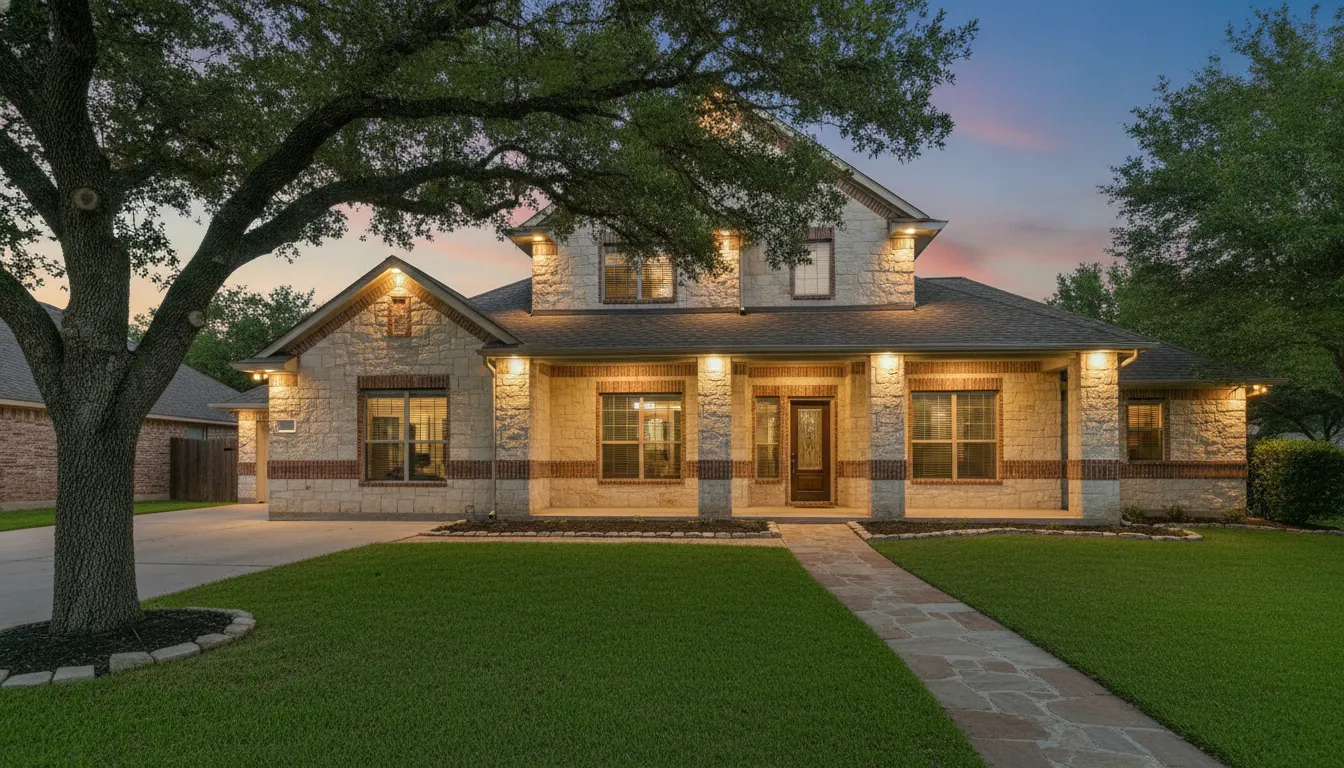
The best permanent outdoor lights fit the roofline, stay hidden in daylight, and still look right on a hot July night or a cool December evening. A long color list on a product page does not decide it. TX Gutter Solutions installs JellyFish and Bosso Smart Lighting for that job. Both stay mounted year-round. You switch among accent, security, holiday, and game-day looks from your phone.
This guide is a buying choice, not a sales sheet. It shows what "best" means on a Central Texas house, how the two systems differ, and where a lighting track belongs. It does not price a project or teach a do-it-yourself install. Those answers depend on the house, and a free estimate is the honest way to get them.
Call (512) 988-3110 for a free lighting estimate or request one online.
What Makes the Best Permanent Outdoor Lights
A clip-on string is a weekend project. Permanent outdoor lighting is a finished part of the house, alongside the gutter installation and repair work on the same roof edge. The track sits under the eaves, and the wiring stays hidden. You change the look from an app instead of a ladder. On the permanent outdoor lighting page, that means one system for accent, security, holidays, and game day.
Shoppers searching for the best permanent outdoor lights usually land on big-box kits. Those kits can be fine for a short porch. They are a poor match for a long eave, a two-story gable, or a home that needs the lights to disappear when they are off. A pro system is built as a track, sealed for weather, and aimed so the bulbs stay hidden from the street.
Heat is the other test that a product page rarely shows. A July afternoon in Central Texas bakes anything mounted on a south-facing soffit. Ultraviolet-protected lenses and a track built for the outdoors are the baseline, not a luxury. Cheap housings chalk, fade, and pull away from the fascia long before the diodes themselves fail. That is why the mounting line matters as much as the color chart.
A Track, Not a String of Bulbs
Both systems TX Gutter Solutions installs use a low-profile track with three high-output LEDs per bulb. The track stays out of street view, and the lenses are ultraviolet protected because summer sun fades cheap plastic. A faded track on a limestone or brick facade is hard to ignore once you have seen it.
Hidden wiring, sealed connections, and a clean finish are part of the install, not extras you add later. If you can see loose wire along the fascia, the installation is not finished. The same crew that hangs seamless gutters already works on that edge of the roof, so the lighting and the water line can be planned together.
One System, Four Jobs
A good system does four jobs without a second set of lights:
- Accent. A warm wash on stone, brick, or columns so the house looks finished after dark.
- Security. A brighter mode that improves visibility and makes the front of the house harder to approach unseen.
- Holiday. Programmable color for the season, without storing bins of strands in the garage.
- Game day. Team colors on the peaks and porch when you want them, then back to white the next morning.
If a system only does one of those jobs well, it is not the best fit for a Central Texas home, even when the color chart looks impressive. The lighting page also notes a night mode, a soft glow after hours so the house stays visible without a harsh wash toward the street.
JellyFish or Bosso: Which System Fits?
TX Gutter Solutions installs JellyFish and Bosso Smart Lighting. The lighting page states the difference that decides most jobs, which is supply voltage and run length. JellyFish uses 48 volts and supports longer runs, up to 1,000 feet. Bosso runs on 12 volts with compact, low-profile power supplies.
The rest of the comparison comes from the same permanent outdoor lighting page, checked for this draft. That page says both systems are controlled from iOS and Android apps, with instant updates and a live preview. It lists more than 16 million color combinations and 500-plus preset effects and animations. It also lists timers and schedules, plus separate zones for the front yard, peaks, porch, and backyard. Those shared features do not pick a winner. The house does.
| What to compare | JellyFish | Bosso Smart Lighting |
|---|---|---|
| Voltage. | 48 volt. | 12 volt. |
| Best run. | Longer runs, up to 1,000 feet. | Runs that suit a compact power supply. |
| Power supply. | Built for long eave runs. | Compact, low-profile supply. |
| Control. | Phone app for iOS and Android. | Phone app for iOS and Android. |
| Color, as stated on the lighting page. | More than 16 million colors and 500-plus presets. | More than 16 million colors and 500-plus presets. |
| Zones, as stated on the lighting page. | Separate areas, including front yard, peaks, porch, and backyard. | Separate areas, including front yard, peaks, porch, and backyard. |
| Energy use, as stated on the lighting page. | Each LED under 1 watt. About 1 amp per 100 feet. | Each LED under 1 watt. About 1 amp per 100 feet. |
| Install. | Licensed, bonded, and insured crew. | Licensed, bonded, and insured crew. |
Choose JellyFish for a Long Roofline
A 48-volt system is the practical pick when the lighted path is long. Think of a wide ranch, a wrap porch, or a house where the front, side, and back should read as one run. JellyFish is the system the lighting page calls out for runs up to 1,000 feet. Fewer power jumps means a cleaner install and fewer boxes to hide.
Long runs are common on newer Central Texas houses. Many of them spread outward instead of stacking up, with deep porches and long soffits. If the plan is to light the whole outline, start the conversation with JellyFish and confirm the path on site. A corner lot with a long side yard is the same kind of job. The side the street sees should not be a different product from the side the family uses.
Choose Bosso When the Runs Are Shorter
Bosso is the 12-volt system, with compact low-profile power supplies. It fits when the lighted areas are broken up, such as a front gable, a covered patio, and a garage. A smaller supply is easier to place in a tight soffit, a garage corner, or crowded attic access.
Shorter, separate zones also suit older homes and additions. A 1970s Austin house with a later garage, or a San Antonio limestone cottage with a new back porch, rarely wants one giant loop. Bosso lets each piece stay sleek without forcing a long-run design onto a house that was built in stages.
Do Not Pick From a Spec Sheet Alone
Voltage is the published difference, but it is not the whole decision. Soffit depth, fascia condition, and outlet location all change the layout. So does the number of sides you want lit. A free site visit is where those get measured. Bring daylight photos of the eaves if you want a head start, and expect the crew to confirm the path in person.
Three House Layouts, and Which System Fits
Specs get clearer when you put them on a real shape of house. These three layouts use only the capabilities published on the lighting page: run length, voltage, compact supplies, zones, and the four scenes. They are examples, not quotes. The site visit still decides the final path.
A Long Ranch With One Continuous Eave
Picture a single-story ranch in a newer subdivision north of Austin or on the edge of the Dallas-Fort Worth suburbs. The front eave runs the full width of the house, turns the garage, and continues down a side that faces the street. Add a back patio cover and the lighted path can pass several hundred feet before you are done. That is the job JellyFish is built for. The lighting page puts its 48-volt runs at up to 1,000 feet, so one supply plan can cover the outline instead of a chain of small boxes.
Zones still matter on a long house. The front eaves stay a warm accent most nights. The entry gets its own slightly brighter setting so the address and the steps read from the drive. The garage and the back patio are separate, so a late patio dinner does not force the street side to full brightness. Holiday color can sit on the front run only. Game-day color can do the same, then drop back to white the next morning. The long run is one system. The scenes are not one switch.
What you check before that choice is the fascia line. A long eave shows every dip in the line. If a section sags or the gutter on that side is due for work, plan it with the track. The same edge of the roof carries both, and doing them in one visit keeps the line straight.
A Split House With a Garage and a Back Porch
A lot of Central Texas homes are not one clean rectangle. A front gable, a side garage that was added later, and a covered back porch are three short runs, not one long one. Bosso fits that shape. Its 12-volt system uses compact, low-profile power supplies, which are easier to tuck into a tight soffit or a garage corner than a supply sized for a thousand-foot loop.
Give each piece its own zone. The front gable carries accent and the occasional holiday look. The porch stays a calm warm white for evenings outside. The garage zone handles coming and going, and it can shift to a brighter security mode after hours. The lighting page lists front yard, peaks, porch, and backyard as the kind of areas you control separately, and it says zones are unlimited. A split house is exactly why that matters. One scene for the whole property would wash the bedroom windows every time the porch lights came on.
This is also the layout where a compact supply earns its keep. Older additions often have shallow soffits and crowded attic access. A low-profile supply can sit close to the run it feeds. You are not trying to hide a large box behind a short fascia return. The crew still confirms outlet location on site. The point of the example is the shape of the house, not a promise that every short run is Bosso.
A Mixed-Material House, Stone in Front and Siding in Back
Brick and limestone take light differently from painted siding or fiber cement. A limestone front in San Antonio, or a brick elevation common around Dallas, can look flat under a cool white and warmer under a softer setting. The back of the same house, often siding or a later addition, reflects more and can look brighter at the same setting. The best permanent outdoor lights on that house are not a different product on each face. They are one system with zones you can tune.
Use the front zone for a warmer accent that flatters the stone or brick. Use the back zone a step dimmer so the siding does not glare into the yard. Peaks get their own zone so a tall gable does not overpower a low porch. Both JellyFish and Bosso support that split, because both offer separate zones, timers, and the full color range. The voltage choice still follows the length of the run. A wide stone ranch with a long front and a long side points back to JellyFish. A compact limestone cottage with a short front and a new porch points back to Bosso.
Test the scene at the estimate, in the evening if you can. A photo on a phone is a start. Standing in the driveway and looking at the stone is the better test. The app's live preview, which the lighting page lists under cloud app control, is how you confirm the look before anyone commits to a holiday calendar or a nightly schedule.
Where the Best Permanent Outdoor Lights Belong
Placement is half of what makes a system look expensive. The other half is knowing when to leave a section dark. The goal is a clean line you notice at night and forget during the day.
Start With the Front Eaves and the Entry
The front roofline and the door are the first places most homes should light. A warm setting on the eaves gives the facade shape. A slightly brighter zone at the entry makes the address and the steps easy to see. Peaks deserve their own zone so a tall gable does not overpower a low porch.
Brick and limestone, the two faces you see all over Austin, San Antonio, and Dallas-Fort Worth, take light differently. Stone can look flat under a cool white and warm under a softer setting. That is a reason to test a scene at the estimate, not a reason to buy a different product for each city.
Give the Porch, Garage, and Backyard Separate Zones
A porch used at night wants its own control. So does a back patio, and so does the garage. The lighting page says you can create unlimited zones for the front yard, peaks, porch, and backyard, so you are not stuck with one switch for the whole house. A common layout is four zones: front eaves, entry, garage, and backyard. Game-day color can stay on the front while the back stays a calm white.
Driveways and side yards are optional. Light them when they are part of how you come and go, or when a dark side gate is a real concern. Skip them when they only add glare toward a neighbor's windows at night. A short path from the drive to the door is usually worth a zone. A full wash across the lawn rarely is, and it is often the first thing a neighbor notices.
Leave Room for Trees, Night Mode, and the Street
Live oaks and cedar elm throw shade and drop debris. A track under a heavy limb can look uneven, and a limb that rubs the fascia will rub the track too. Note those spots before install day. The lighting page also calls out a night mode: a subtle glow or a security setting after hours, so the home stays visible without being harsh. Many neighborhoods prefer that over a full-bright wash, and the page notes that accent lighting for safety is encouraged by law enforcement and HOAs.
Security here is a mode, not a promise. The page describes brighter, including motion-activated, light that improves visibility and can deter unwanted activity. It does not replace locks, cameras, or a porch light you already trust. If you are comparing homes across the region, the service area pages show where crews already work, from Austin and San Antonio to Dallas and the wider metro.
What to Check Before You Book an Install
The best system still fails if the edge of the roof is tired or the plan is vague. Walk these checks before you ask for a number. None of these checks require you to climb a ladder.
Check the Fascia, Soffit, and Gutters
Tracks mount along the same edge as the gutters. Soft fascia, a stained soffit, or a sagging gutter will show up the day the lights go on. If the wood is soft, or the gutter needs to come down anyway, do that work first or in the same visit. A lighting quote on failing fascia just means a second project later. The fascia repair guide covers what to fix before anything new hangs on that board. The wood fascia board guide is the closer look when you are unsure the board can hold a track.
You do not need a full gutter replacement to be a candidate. You do need a solid mounting line along the eave. If you are unsure, say so on the estimate form. A look at the eaves is part of planning the job, and it is free. Stains on the soffit are a separate clue. The soffit and fascia water damage signs page is worth a read before you hide that edge behind a new track.
Decide the Zones Before the Crew Arrives
Write down the areas you care about, in order. Most homes land on four or fewer. A short list keeps the install focused and the app simple after the crew leaves. For each zone, note the job: warm accent, brighter security, holiday color, or game day. You can change scenes later. You cannot easily add a zone that was never wired.
Also note where you do not want light. A bedroom window, a neighbor's patio, and a dark sky toward the back fence are worth flagging. Aim and zone choices are much cheaper on paper than after the track is up. If a room faces the eave, say so. A night-mode glow is easier to plan than a track aimed into a window.
Confirm Who Is Doing the Work
The lighting page says installs are performed by licensed, bonded, and insured professionals. It also describes attention to hidden wiring, proper sealing, and a clean finish. Ask the quote to name the system, the areas, where the power supply will sit, and how the app is handed off. A clear written scope is the useful part. A logo on the truck is not a scope.
A free, no-obligation estimate is the offer this guide stands on. The company is family-owned and veteran-led, and the work is local to Central Texas. That is useful context for who stands behind the job. It is not a substitute for a written scope, and this article does not describe payment plans.
Energy use is the other number the lighting page publishes, and it is worth knowing before you compare kits. That page says each LED pulls under 1 watt, and the whole system averages about 1 amp per 100 feet of lighting. That is a published draw, not an estimate of your electric bill. Your utility rate and your hours of use still decide the cost.
- Photograph the front eaves, each gable, the porch, and the garage in daylight.
- List the zones you want, and mark any window or neighbor you do not want to light.
- Note fascia stains, sagging gutters, or limbs that touch the roof edge.
- Pick a first scene: everyday warm white, security, or a holiday look.
- Ask the estimate to name JellyFish or Bosso, and why that one fits the run.
How a Lighting Estimate Works
The lighting process is four steps, and none of them start with a hard sell. You book a free consultation online or by phone. The crew evaluates the house and sets clear expectations. Installers do the work and leave a clean finish. A final look confirms the zones, the app, and the scenes you asked for. The lighting page calls those steps a free estimate, project planning, professional installation, and a final inspection.
Use the contact form and choose permanent lights, or call the Austin office at 512-988-3110. The same form covers San Antonio and Dallas-Fort Worth. It also covers gutter work if the eaves need attention before a track goes up. City pages for Austin, San Antonio, and Dallas are the right next stop if you want to see the local service before you call.
Bring the zone list and the daylight photos to that visit. Ask which system fits the measured run, where the supply will hide, and which scene you will see first. A useful quote names JellyFish or Bosso and says why. It also names anything on the fascia that should be fixed first. If the lights are already up and something is wrong, that is a different article. Repair, flickering, and maintenance for an existing roofline system are covered in the permanent roofline lighting repair guide. This page stays on the choice of a new system.
Ready to see which system fits your eaves? Get a free, no-obligation lighting estimate or call (512) 988-3110. We will name the run, the zones, and the system before any work is scheduled.
Frequently Asked Questions
What Are the Best Permanent Outdoor Lights for a Texas House?
For homes we serve, the best permanent outdoor lights are a pro track, either JellyFish or Bosso, matched to the length of the run. JellyFish is the 48-volt option for long eaves, up to 1,000 feet. Bosso is the 12-volt option with a compact power supply. Both hide under the eaves and run from a phone. The lighting page is the source for those specs.
How Do I Choose Between JellyFish and Bosso?
Start with the length and shape of the lighted path. A long, continuous roofline points to JellyFish. Shorter, separate areas point to Bosso. Color range, presets, timers, and zones are shared, so they should not decide it. A site visit confirms soffit depth, power, and fascia before either system is ordered.
Can One System Handle Holidays, Security, and Game Day?
Yes. Both systems cover accent, security, holiday, and game-day scenes from the app, with timers and separate zones. You can leave the entry on a soft night mode and put color only on the front gable. You do not need a second set of lights for the seasons. Motion-activated brightness is part of the security look the lighting page describes, not a separate product.
Will the Lights Show During the Day?
They should not stand out. The track is low profile, with three high-output LEDs per bulb, and it is meant to stay hidden from street view. The lenses are UV protected. A clean install also hides the wiring and seals the connections. If a section of fascia is damaged, fix that first so the track has a straight line to follow.
How Much Power Do Permanent Outdoor Lights Use?
The lighting page says each LED pulls under 1 watt, and a full system averages about 1 amp per 100 feet of lighting. That is the figure published there, not your bill. Runtime, scene brightness, and your utility rate still decide what you pay. A schedule and a night mode keep the system from running full bright all evening.
How Do I Get a Lighting Estimate in Austin, San Antonio, or Dallas?
Request a free, no-obligation estimate on the contact page and select permanent lights, or call 512-988-3110. The visit covers the path, the zones, and which system fits. Nothing is scheduled until you have seen the plan, and the estimate itself is free and carries no obligation.