
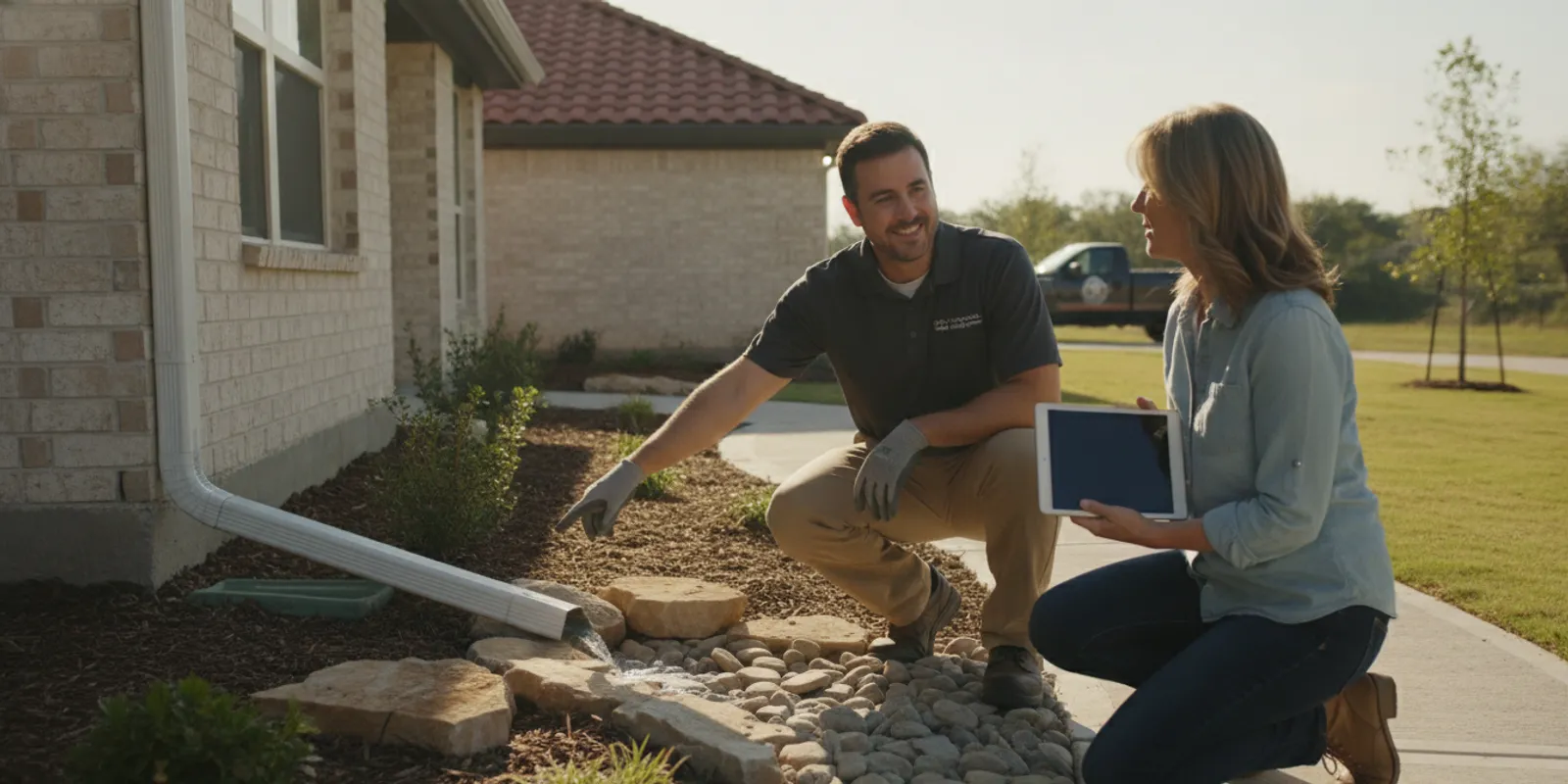
Choosing residential drainage contractors after construction starts with one question: where is the water coming from, and where does it go? New roof areas, compacted soil, patios, walks, and changed grades can alter runoff paths. A careful review connects the visible symptom to its source before anyone recommends a particular component or installation.
Request a free, no-obligation estimate
What should residential drainage contractors assess first?
A contractor should follow the water path across the property rather than treating a puddle as an isolated problem. Begin at the roof, where rain lands, then follow it through the gutter, downspout, and discharge point. Next, look at how water moves across the ground near planting beds, paved areas, low spots, and the home's perimeter. The point is not to diagnose the system yourself. It is to understand what should be inspected and to make sure the recommendation addresses the complete route.
New construction can change several parts of that route at once. A larger or differently shaped roof may collect runoff along new edges. A driveway, patio, or walkway can redirect surface flow. Soil disturbed during building may settle or become compacted. Fresh landscaping can change the direction water takes. These are possible contributing conditions, not proof that the home needs a specific drain or that construction caused a defect.
During an initial assessment, ask the contractor to identify observable evidence at each stage:
- Collection: Which roof sections or ground areas contribute water to the trouble spot?
- Conveyance: Do gutters, downspouts, channels, or visible surface paths carry it onward? Are there signs of overflow, separation, blockage, or interruption?
- Travel: Does water run along a slope, cross a hard surface, or collect in a low area? Are there marks showing repeated flow?
- Discharge: Where does the water leave the system, and what happens there? Is it directed toward a suitable area, or does it stop beside a structure or in another problem location?
- Site context: Have grading, roof edges, paving, retaining features, or landscaping changed since the water issue first appeared?
A sound explanation distinguishes what was observed from what is still uncertain. A contractor might see that a downspout releases water near a wet area, for example, but need to observe a rain event to determine whether that outlet is the only source. Ask what evidence supports the diagnosis and what additional information would help separate competing explanations.
How can you document the problem before a visit?
Useful documentation is simple and repeatable. Take photographs or short videos from a safe location during or soon after rain. Include a wide view that shows the house, nearby hard surfaces, and the low area, then take closer views of relevant roof edges, gutter sections, downspout outlets, erosion marks, and standing water. Avoid climbing ladders or entering areas where water is moving quickly.
Pair the images with a short log. Record the date, approximate rainfall conditions if known, where water first appeared, how far it traveled, and how long it remained visible. Note whether the pattern recurs after ordinary rain or only during a particularly strong event. If irrigation, a leaking hose, or another water source could be involved, write that down too. This helps a professional avoid assuming every wet area is caused by roof runoff.
Make a simple site sketch if the layout is difficult to explain. Mark the roof edges, downspout locations, patio or driveway, known low points, and the area where water is observed. Arrows can show the apparent flow direction. Label the drawing as your observation rather than a measured grading plan. A hand sketch is a conversation aid, not an engineering document.
Collect relevant before-and-after material when available. Construction photographs, landscape plans, site plans, builder notes, and pictures from before a patio or walkway was installed may help explain what changed. Do not delay requesting an assessment because a plan is missing. The practical goal is to give the contractor a clear timeline and enough context to ask useful questions.
- Write down when you first noticed the water pattern.
- List work completed nearby, such as roof, paving, landscaping, or grading changes.
- Point out the first visible water, the route you observe, and the endpoint.
- Describe what you know and separate it from what you suspect.
- Keep copies of photos and written observations so every person reviewing the issue can refer to the same information.
How do you compare residential drainage contractors?
Look for a contractor who explains the observed condition before presenting a solution. The explanation should connect the starting point, route, and endpoint to the work being proposed. A product name by itself does not show why that product fits the property. Ask the contractor to describe what it will collect, how water will move, and where it will go.
It is also reasonable to confirm that the company performs the work in the proposal. Home water management can involve gutters, downspouts, drainage components, and site conditions, but providers do not all offer the same scope. Review the current gutter and drainage services to understand the types of work TX Gutter Solutions describes. If your concern appears to involve roof runoff, the page on gutter installation and repair can help you frame that part of the discussion. A service page is a starting point; an on-site review still needs to determine the relevant work.
| What to compare | Question to ask | What a useful answer should clarify |
|---|---|---|
| Observed condition | What did you see that explains the water pattern? | The visible source, route, and area affected, plus any remaining uncertainty. |
| Collection method | Where will water enter the proposed system? | The specific roof edge, surface, or area the work is intended to collect. |
| Route and endpoint | Where will the water travel, and where will it discharge? | A clearly described route and endpoint that suit the property conditions. |
| Work boundaries | What is included, and what is outside the proposed scope? | Locations, components, connections, access requirements, and exclusions. |
| Site restoration | What happens to surfaces or landscaping disturbed during the work? | Which restoration tasks are included, excluded, or dependent on site conditions. |
| Care after completion | What should I inspect and maintain? | Practical upkeep steps and signs that call for follow-up. |
| Written terms | Where are workmanship and material terms stated? | The applicable written terms without relying on an informal verbal summary. |
Compare proposals by the work described, not by labels alone. Contractors may use different names for similar approaches, or use the same label for systems with different layouts. Ask each person to mark collection points, the route, and the outlet on a sketch or site plan. If a proposal depends on a particular assumption about soil, grade, existing pipe, or outlet access, ask that assumption to be recorded clearly.
Make sure the document addresses connections to existing components. A new collection point is only useful as part of a working path. Confirm whether the proposal includes tying into an existing downspout, moving or replacing a section, dealing with an obstruction, or protecting nearby surfaces. Also ask how the contractor will handle a condition discovered after work begins. The answer should clarify how changes to the agreed scope will be discussed and approved.
Which questions reveal whether a recommendation fits?
Ask direct questions and listen for answers tied to the property rather than a generic explanation. The questions below can be used during a site visit or when reviewing a written proposal.
- What exactly did you observe that points to this source of water?
- Could more than one source contribute to the same wet area?
- What does the proposed work collect, and what does it not collect?
- How will water travel from the collection point to the discharge location?
- What nearby areas might receive water after the route changes?
- What maintenance access will be needed once the system is in place?
- What site condition could require a revised plan?
- How will we check whether the intended route is operating after the work?
Good questions invite a clear explanation, not a promise that every future water issue will disappear. Water behavior can depend on rainfall, surrounding surfaces, upkeep, and conditions beyond the work area. A proposal should say what the planned work is designed to do and identify meaningful limits. That makes expectations easier to understand before work starts.
Notice whether the contractor takes time to hear your account. The timing and pattern of water can be important. If a recommendation seems to skip over the information you provided, restate the observation and ask how it fits the diagnosis. A professional discussion should allow reasonable questions about both the proposed work and other possible causes.
How can the visible symptom guide the inspection?
A symptom can help focus an assessment, but it does not prove a cause. A narrow wet strip below one roof edge may make the gutter and its outlet worth inspecting. A broad flow line across a yard may lead to questions about surface grade and nearby hardscape. Water that returns around a particular low area may require a wider look at contributing areas and the available discharge route. Treat these clues as prompts to investigate, not as do-it-yourself design instructions.
When should gutters and downspouts be part of the review?
Look for visible overflow in rain, water passing behind a gutter, a loose or disconnected downspout, debris, sagging sections, or an outlet that releases water near the area of concern. A gutter can collect roof runoff but still leave a problem if the outlet ends in an unsuitable place. Conversely, a wet yard area may have another source even when a downspout is nearby.
Ask the contractor to trace the roof section feeding the outlet and follow the route to its end. If water appears to be released too close to the home, ask whether a suitable alternate discharge location exists and what conditions affect it. TX Gutter Solutions has a guide to downspout replacement considerations, which can help you prepare questions about this component. Use the article as background, not as a substitute for checking your specific layout.
When should surface flow and hard surfaces be discussed?
If water follows a visible route over a driveway, walk, patio, or lawn, ask how that surface affects the flow. New paving can change where water travels because it creates a different surface from soil or planting beds. A contractor may discuss a collection point or a change to the route, but the design needs to show how water reaches that point and where it leaves afterward.
Ask what happens at the edges of the hard surface and whether water can bypass the proposed collection area. If the water arrives from a larger area than the proposed inlet can collect, the plan should explain how that condition is accounted for. The purpose is not to specify a drain yourself. It is to check that the recommendation relates to the actual route you observe.
When should a buried or below-grade option be evaluated?
A below-grade system may be discussed when an assessment identifies a workable collection method and discharge route. Ask what will be installed below ground, how it will connect to other components, and how it can be inspected or maintained. The contractor should identify the endpoint and discuss any site constraints that affect the plan.
Do not assume that an underground pipe is appropriate just because the problem is near a foundation or because a yard has a wet patch. First establish what water is being collected and whether the intended route has a suitable end. When a proposal is difficult to visualize, request a drawing that shows the connection points and the route in relation to the home and other surfaces.
What does a proposal need to say about discharge?
Discharge deserves specific attention because collecting water without a workable endpoint may shift the problem rather than resolve it. Ask the contractor to name or mark the intended outlet. Discuss whether it is accessible, whether the route can be maintained, and what happens to water at that location during the conditions the work is intended to address.
Consider the surroundings as well as the point directly beside the house. The endpoint should not simply direct water toward a new trouble spot, obstruct a walkway, or create an unwanted flow across a neighboring area. If the proposed outlet is near a boundary, slope, paved surface, or planting area, ask how those conditions were considered. The contractor can explain the planned route and any limitations; do not assume a generic outlet location is suitable on every property.
Ask whether the proposal depends on an existing drain or connection. If so, confirm whether that component will be inspected and whether checking or clearing it is included. An existing line that cannot accept or convey water as expected may affect the performance of new upstream work. If the assessment cannot verify an existing component, request that the uncertainty and next step be noted.
A simple sketch can make the discussion concrete. It should show the collection point, route, connection points, endpoint, and nearby features that matter. A sketch is not a substitute for technical plans where those are needed, but it can reveal whether everyone understands the same intended path.
How do you handle uncertainty after recent construction?
When water behavior changes after building work, keep a neutral record of the sequence. Note when construction and landscaping occurred, when you first observed the water issue, and whether the condition appears consistently. The timing may help professionals investigate, but timing alone does not establish why the water behaves as it does or who is responsible.
You can ask the builder or site-work professional what grading and drainage details were intended, especially if plans or completion documents are available. Share the same photos and observations with each professional. Keep descriptions factual: “water collects beside the west walk after rain” is more useful than deciding in advance that a particular installation is faulty.
If the first visit occurs during dry weather, explain when the issue is visible and share your records. Ask whether the contractor can assess the relevant components under the conditions available and what cannot be confirmed without rainfall. A recommendation may be provisional if a critical part of the route is not visible or accessible. That limitation should be explicit, with a practical next step rather than an unsupported conclusion.
Where several causes remain possible, ask what observation would distinguish them. For example, does water appear first at the downspout outlet, or does it arrive from a wider part of the yard? Does a wet area recur when irrigation is off? Does overflow occur at the roof edge before water reaches the ground? These observations help direct a follow-up without asking you to alter a system or conduct risky tests.
What should you expect during an estimate conversation?
An estimate discussion is most useful when it connects your evidence to a defined scope. Explain the issue in your own words, show the photos or sketch, and point out changes made during construction. Then ask the contractor to walk through the findings before discussing a proposed solution. This order makes it easier to spot a mismatch between the observed problem and the suggested work.
Before the conversation ends, repeat back the main points: what condition the work is intended to address, what parts of the property are included, where collected water will go, and what remains uncertain. Ask for the proposal in writing so that the description can be reviewed without relying on memory. If more than one approach is proposed, request the practical difference between them, including what each collects and what upkeep it requires.
TX Gutter Solutions describes free, no-obligation estimates as a way to begin a service conversation. If you want to understand the company's background before contacting the team, review its company information and the service-area information to confirm that your location is within the areas it describes. Those pages can answer basic company and coverage questions; the estimate conversation should address the conditions on your property.
What are two examples of a careful assessment?
Example one: water below a downspout after a patio was added
A homeowner notices a wet strip near a downspout after a patio is built. The first useful step is to check whether the gutter is collecting roof water and whether the outlet is connected and clear. The contractor then follows the discharge route and observes how the patio edge and adjoining ground affect the water. The wet strip could be related to the outlet, the new hard surface, or both; the observation alone does not settle the cause.
A useful proposal would state which source it addresses, how water will be conveyed, and the intended endpoint. It would also say whether any work on the patio edge or surface is included. If the plan only changes the downspout but the observed flow also crosses the patio, the homeowner can ask whether that part of the route was evaluated. The lesson is to connect the scope to the complete path rather than selecting a component from the first visible symptom.
Example two: a low spot appears after landscaping
Another homeowner sees recurring water in a low part of a newly landscaped yard. There is no obvious gutter overflow, and the area is some distance from the nearest downspout. A careful assessment looks beyond the puddle: nearby roof outlets, surface slopes, walks, recently moved soil, and any changes to planting beds may all be relevant. Photos from before the landscaping can help describe what changed without assigning blame.
If the cause is not clear during a dry visit, a contractor can explain which observations are still needed. A proposal should not imply that collecting water at the low spot alone will address every contributing source unless the route has been assessed. The homeowner can ask for a sketch, a description of the outlet, and a clear statement of what the recommended work is designed to accomplish. This keeps the decision focused even when the answer requires another observation.
How do you compare two different recommendations?
Two contractors may inspect the same area and recommend different work. That does not automatically mean one is wrong. They may have interpreted the evidence differently, focused on different parts of the route, or assumed different endpoints. Compare the reasoning step by step instead of choosing based on the name of the system or the confidence of the presentation.
First, ask each contractor to identify the condition being addressed. One may focus on roof runoff leaving a downspout; another may believe surface water is moving across the yard. Ask what observations support each view. If the explanations conflict, look for the specific fact that could resolve the difference. It may be a rain-time photo, a check of an existing connection, or a closer look at a hard-surface edge. Do not ask a contractor to endorse another person's conclusion without reviewing the relevant evidence.
Next, compare the intended water paths. For each proposal, identify the collection point, every connection or transition, and the endpoint. If a proposal stops at “install a drain” without showing where water travels afterward, request the missing information. If a route relies on an existing pipe or outlet, ask whether that part has been examined or whether its condition is an assumption.
Then compare the boundaries. One scope might include a specific area and connection, while another might include additional adjustments or surface restoration. Write down what is included, what is excluded, what could change after work begins, and who will discuss changes with you. Ask both contractors to explain the maintenance access their design requires. This helps make clear whether different recommendations are actually comparable or solve different portions of the problem.
Finally, compare how each contractor describes uncertainty. A careful proposal can identify limits without being vague: it can state what was observed, what the work is intended to address, and what cannot be confirmed yet. If one explanation seems incomplete, ask a focused follow-up rather than trying to infer the missing design details yourself. You can take time to review the written scopes and ask each contractor the same core questions. A consistent comparison gives you a clearer basis for deciding what conversation or assessment should come next.
What should you check after the work is complete?
Use the agreed scope as a checklist. Confirm that the components described in the proposal are present in the intended locations and that visible connections and outlets match the plan. Ask the contractor to show you any access points or parts that require routine attention. Keep the final written description and any drawings with your property records.
After a suitable rain, observe the route from a safe location. Look for whether water enters the collection point, follows the intended path, and reaches the stated endpoint. Note unexpected overflow, a disconnected section, new pooling, or erosion. One event may not represent every condition, so record what you see and contact the contractor if it differs from the agreed purpose or if a connection appears to need attention.
Maintenance is part of the long-term picture. Gutters and collection points may need inspection and cleaning, while outlets and visible routes should be checked for blockage or damage. Ask which components require attention, how often they should be reviewed under the conditions at your home, and what visible warning signs merit follow-up. Keep expectations tied to the written scope and the actual system installed.
What should make you pause and ask for clarification?
Ask more questions before agreeing to work if the recommendation does not identify the water source, gives no endpoint, or cannot explain how the route fits the site. The same is true if the proposal addresses a puddle but ignores obvious overflow upstream, or if it assumes an existing connection works without checking it. These are reasons to clarify the explanation, not automatic proof that a contractor is unqualified.
Be cautious when a conclusion relies on only one dry-day observation even though the issue occurs in rain. Ask what the visit could and could not establish, and what evidence would help resolve the uncertainty. Request clear written boundaries, including locations, connections, exclusions, site restoration, and maintenance responsibilities. If a contractor is unable to answer a question about an essential part of the plan, take time to seek a clearer explanation before proceeding.
For additional background as you prepare questions, see TX Gutter Solutions' guides to standing water in a yard, yard drainage approaches, and drainage considerations in San Antonio. Each can help you recognize terms and possible approaches. They do not replace a review of the actual property, route, and discharge conditions.
Frequently asked questions
Should I call a gutter contractor or a drainage contractor?
Start with where the water appears to begin. If it seems connected to roof runoff, ask a gutter professional to review the gutter, downspout, and discharge route. If water crosses a larger part of the yard or appears unrelated to a roof outlet, a contractor with relevant drainage experience may be appropriate. Ask what work the company performs and how the proposed scope relates to the observed condition.
Does new construction always need additional drainage work?
No. Construction by itself does not establish that an additional system is needed. Look for a recurring, observable condition such as pooling, erosion, or an outlet releasing water in an unsuitable place, then ask a qualified professional to assess the full route. The assessment may find that a change is not needed or that more information is required.
Can moving a downspout solve standing water?
It may help when roof runoff is being released close to the home and a suitable discharge location is available. It may not address water arriving from another part of the yard, a surface-flow pattern, or a different source. The route and endpoint both matter, so have the full path reviewed before assuming a single adjustment will resolve the condition.
What should I bring to an estimate?
Bring photos, a brief log of when the issue occurs, and any relevant plans or before-and-after images you have. Point out changes made during construction and describe where water first appears and where it seems to go. You do not need to prepare technical drawings; a simple sketch can help explain the layout.
What if I cannot identify the cause?
You do not need to diagnose the issue before contacting a contractor. Share what you have observed and be clear about what you do not know. A useful assessment should distinguish observations from assumptions and explain what additional evidence, if any, would help determine the next step.
Get the water route assessed
When a runoff concern appears after construction, start with the evidence: where water begins, what route it follows, and where it stops. A contractor who explains each part of that path can help you compare scopes and decide whether gutter work, drainage work, or another assessment fits the property. Keep the conversation practical, document what is agreed, and make sure the discharge plan is clear.
Ask about a free, no-obligation estimate
Clear observations and a written route from collection to discharge are the best starting points for comparing residential drainage contractors.