
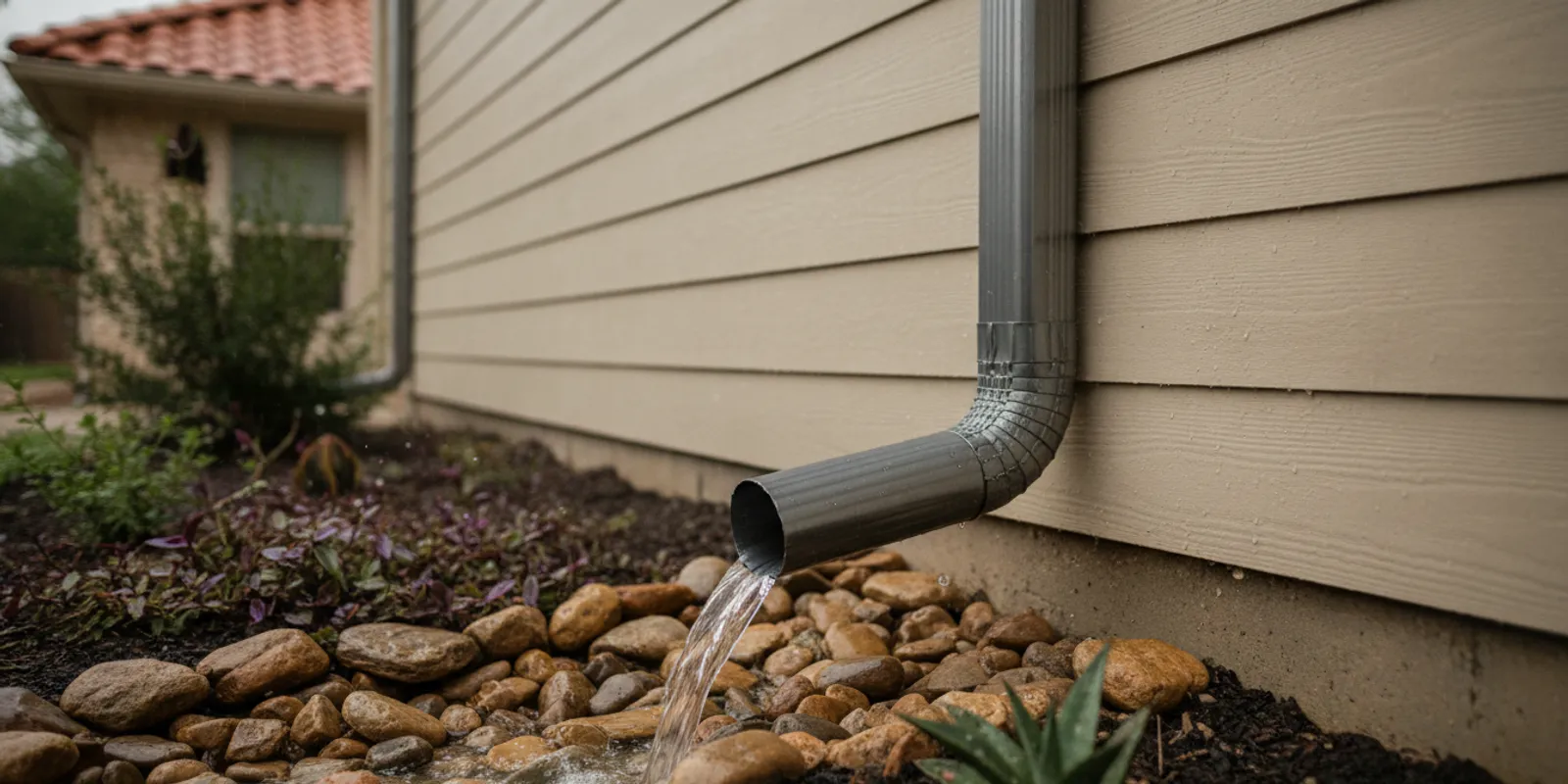
The cost to replace downspout is shaped by more than the visible pipe. Its height, fittings, condition, gutter connection, access, and discharge route all affect the work involved. The useful first question is not simply which part looks worn, but whether the downspout is the cause of the water problem or only one point in a larger route from roof to yard.
Request a free, no-obligation estimate
What does downspout replacement involve?
A downspout is the vertical part of a gutter system that carries roof runoff toward ground level. It may include a gutter outlet, straight sections, elbows that turn the route, straps or other fasteners, and a lower extension or connection. A replacement can involve only one damaged piece, or it can extend from the gutter outlet all the way to the point where water is released.
That difference is important when you compare proposed work. A section replacement addresses a localized defect when the rest of the run remains sound and compatible. A full replacement may be considered when several sections are damaged, the route is poorly fitted, the fittings no longer connect securely, or the existing configuration cannot direct water where it needs to go. Neither approach is automatically the right one; the condition of the connected parts matters.
Work may also include removing and refitting an elbow, securing a loose strap, reconnecting the downspout to its gutter outlet, or adjusting the ground-level extension. Those tasks are related, but they are not the same as replacing an entire system of gutters. If water is spilling over the gutter above the downspout, the gutter itself may need inspection too.
TX Gutter Solutions provides gutter installation, repair, cleaning, leaf protection, and drainage services. Its gutter services overview can help you understand the wider types of work that may be relevant. The specific recommendation should still be based on the house, the observed condition, and the route runoff needs to follow.
What affects the cost to replace downspout?
The phrase cost to replace downspout can describe jobs with very different scopes. A short, reachable piece that connects to sound fittings is not the same project as a tall run with several offsets and a discharge concern. Without inspecting the system, there is no responsible way to assume that two homes need the same work. These are the main scope factors to discuss:
- How much of the run needs attention. A single crushed or detached segment may be isolated. Rust, splits, loose joints, or repeated movement in several places may point to a larger replacement area. The assessment should distinguish the visibly affected section from connected pieces that are still serviceable.
- Height and working access. A downspout on a tall wall, near a roof edge, or above landscaping may take more setup than an easy-to-reach ground-level section. Tight side yards, fences, delicate planting, uneven ground, and nearby equipment can limit where a ladder or work area can be placed.
- Length and route complexity. A straight run has different requirements from a run that must turn around a projection, avoid an opening, or continue toward a practical discharge area. Each offset or transition needs to fit and stay aligned rather than forcing a connection into an awkward position.
- Profile, material, and finish. A replacement needs to work with the existing gutter outlet and downspout shape. The material, profile, and available finish can affect which components are compatible. A visual match is useful, but fit and water flow should come first.
- Condition of the gutter outlet. The downspout may be sound below a connection that is loose, blocked, or damaged. Replacing the lower pipe without checking the outlet can leave the original failure in place.
- Fasteners and attachment surface. A secure run depends on suitable fastening points and a sound surface. Loose straps may be the only issue, but damaged siding, masonry, or fascia near an attachment point can complicate the work and should be identified rather than covered up.
- Ground-level discharge. The extension may be missing, shifted, crushed, or too short for the site's needs. If the outlet repeatedly releases water where it causes pooling or erosion, the work may involve evaluating a different route, not just fitting another vertical pipe.
- Existing water effects. Washed-out mulch, exposed soil, a damp area, or water collecting at the wall should be noted. These observations do not prove the downspout is the sole cause, but they can show why a replacement should be considered as part of the whole runoff path.
- Removal and disposal. A proposed scope may include taking down an old section and handling the removed material. Ask what is included so you can compare work descriptions clearly instead of assuming every estimate covers the same tasks.
These points help explain why a generic answer cannot describe every house. They are prompts for a site-specific conversation, not a guarantee that a particular component must be replaced. A good evaluation should tie each proposed task to something observed: a damaged seam, an unstable attachment, a blocked outlet, or a discharge destination that does not work for the property.
How can you tell whether the downspout needs replacement?
Begin with visible evidence from the ground. A downspout may need attention when it is crushed, split, badly dented, separated at a joint, or pulling away from the wall. Watch also for a missing elbow, an extension that has moved, or water escaping from a seam during rain. These signs help describe the condition, but they do not all call for a full replacement.
Look for patterns rather than a single clue. If one strap is loose and the pipe itself is intact, a repair may be sufficient. If several connections have separated and the body is deformed, replacement of a larger section may be worth evaluating. If a leak appears only where the downspout meets the gutter, the connection or outlet deserves attention. If the pipe looks intact while the yard remains wet, the outlet location or the surrounding grade may be more relevant than the pipe.
When possible, observe the area during or soon after rainfall without going onto a roof or ladder. Note whether water:
- spills over the gutter edge before it enters the downspout;
- leaks from one joint or from several points along the run;
- flows freely from the bottom but pools nearby;
- runs across a walkway, toward a wall, or into a planting bed; or
- appears to stop at a ground-level extension or inlet.
A short video or a few ground-level photographs may help explain what you see. Include the full visible route where practical: the gutter above, the vertical run, the lower fitting, and the place water reaches. Avoid trying to clear a high outlet or pull apart an elevated section yourself if you do not have the right equipment and experience.
For a broader view of what to observe on the system, use this gutter inspection checklist as a companion. It can help you collect observations without treating a homeowner inspection as a substitute for a professional assessment.
Is the downspout the problem, or is the water path?
Runoff travels through several connected points: roof edge, gutter, outlet, downspout, and discharge area. A problem at any one of them can resemble a downspout failure. Tracing the path helps prevent a narrow repair from leaving the underlying symptom unchanged.
Start at the top of the route. If water overflows from the gutter during rain, ask whether debris, a restricted outlet, gutter condition, or the way water reaches that section could be involved. Overflow is not proof that the downspout needs replacement. A clear, intact vertical pipe cannot carry water that never enters it properly.
Next, follow the visible pipe downward. A leak at a joint may suggest a loose or poorly aligned connection. A pipe that bows away from the wall may need its supports checked. A dent can narrow the passage, but its location and degree matter. Then examine the ground-level end. An extension can become disconnected or point in a direction that lets water collect in the same area, even when the rest of the run is functional.
Finally, look at the land around the outlet. Does the surface appear to slope toward the wall? Is there a low spot, a narrow planting bed, a paved area, or a place where runoff has no obvious path onward? These details are part of the site context. They do not by themselves establish a drainage diagnosis, but they help explain why merely replacing a pipe may not answer the homeowner's concern.
- Identify the symptom. Describe whether you see a leak, overflow, loose part, blocked lower end, or pooling. Avoid combining several symptoms into a conclusion such as “the downspout is broken” unless the damage is clear.
- Locate where it begins. Note whether water escapes at the gutter outlet, along a seam, from the bottom, or somewhere in the yard after it leaves the pipe.
- Record when it occurs. Is the issue visible only during rainfall, after a storm, or even when no rain has fallen recently? Timing can help distinguish active runoff from another source of wetness.
- Check the visible discharge route. See whether an extension is present, connected, and pointed toward a suitable area. Do not redirect water onto a neighboring property or a place where it creates another problem.
- Explain what changed. Mention recent landscaping, a moved extension, construction, or a newly noticed leak. This context can guide inspection without requiring you to determine the technical cause.
When the pipe is intact but the yard still collects water, a separate yard drainage concern may be involved. TX Gutter Solutions' guide to yard drainage solutions offers additional context for considering the wider area. The right response depends on the source and where water can safely go.
What replacement choices should you compare?
Once the problem is understood, compare the scope and purpose of possible fixes. The following table is a discussion aid, not a recommendation for every property. A contractor should check the connected parts and explain why a particular option fits the observed condition.
| Approach | May be considered when | Questions to ask |
|---|---|---|
| Refasten or realign | The run is intact but has shifted or come loose at a support. | Are the fasteners and attachment surface sound? Will the pipe remain aligned? |
| Replace one section or fitting | Damage is limited to a discrete piece and nearby connections remain usable. | Will the replacement fit the existing profile and connect securely? |
| Replace the full downspout run | Damage, poor fit, or failing connections occur in several parts of the vertical run. | Does the scope include the gutter outlet, elbows, supports, and lower end? |
| Add or reposition an extension | The downspout carries water but releases it too close to the wall or into a problem spot. | Where will the water go, and will the extension stay connected and clear? |
| Evaluate a broader drainage route | Surface discharge repeatedly contributes to pooling, erosion, or an awkward flow path. | What is the destination, how can the route be inspected, and what maintenance may be needed? |
A section repair can preserve sound components, but the replacement piece still has to match and join properly. A full run may create a continuous, well-supported path when several parts are compromised, but it does not automatically fix an unsuitable outlet. An extension can help guide surface flow, but only if there is a suitable place for that water to travel. A more involved route raises its own questions about destination, access, and future inspection.
Ask the person evaluating the work to identify what is being changed and what is staying. If the recommendation is to replace the whole run, ask which visible conditions support that scope. If the recommendation is limited to one piece, ask how the surrounding joints and supports will be checked. If a drainage change is proposed, ask how it addresses the observed water behavior and what the maintenance considerations are.
The company's guide to gutter parts and accessories can help you recognize the names of common components before a conversation. Knowing the terms can make it easier to clarify whether a proposal refers to an elbow, outlet, extension, strap, or another part.
How do height, access, and layout change the work?
Two downspouts that look similar from the street can be quite different to work on. A straight run beside a clear path may be accessible. A run tucked behind landscaping, close to a fence, above a sloped surface, or beside delicate exterior details may require a different setup. Those conditions affect how a worker can reach the part, remove it, keep the area protected, and install the replacement securely.
Height matters because elevated work needs safe access and careful handling. The number of stories is only one part of that picture. A side wall may be obstructed by a porch roof, an awning, a tree, or equipment. Ground conditions can also matter: a ladder needs a stable placement area, and planting beds or uneven ground can restrict access. If you know about an obstacle, point it out when describing the job rather than assuming it will be apparent from a distant photo.
Layout matters for the water route as well as the installation. A downspout may need offsets to clear a window, trim, or projection. Each change in direction creates another connection to fit and secure. A lower extension can have to pass a walkway or landscape edge. Discuss whether the proposed route keeps water moving freely while avoiding trip hazards and preventing discharge onto a neighboring lot or an unsuitable surface.
Material and appearance are practical considerations, too. A replacement that differs sharply in shape or finish may not suit the existing system. But color alone should not drive the decision if the replacement cannot connect correctly. Ask which profile and material are proposed, how they join to the current gutter outlet, and whether any visible mismatch is expected. If matching components are not readily available, the options should be explained rather than assumed.
Finally, consider what must be moved or protected. A dense shrub directly below the run, outdoor furniture, a gate, or a narrow access path can change the work area. You can make access easier by moving portable items when safe and practical. Do not cut plants, detach equipment, or alter the gutter system in preparation unless the contractor has asked you to do so.
How should material, shape, and fit be evaluated?
A replacement is not simply a length of pipe that looks close to the old one. The profile has to work with the gutter outlet, elbows, and other connected pieces. Before work begins, identify which parts will remain and which will be changed. This helps reveal a mismatch that might otherwise become apparent only during installation.
Start with the visible geometry. Downspouts may have different shapes and dimensions, and the outlet above them must transition into the selected run. An elbow turns water around a corner or changes direction near the bottom. If a new section uses a different profile, the connection needs to be considered rather than forced together. Ask whether the existing outlet and elbows are compatible and whether any transition fitting is included.
Next, consider material and finish. The replacement should suit the rest of the assembly and the home's exterior, but visual coordination is only one concern. A component that is attractive but does not fit well is not a sound choice. If an exact match is unavailable, ask what alternative is proposed and how it will connect. It is also useful to discuss what will be visible from common viewing areas, especially when only one portion of a longer run is changing.
Fastening deserves the same attention as fit. Supports should hold the pipe in its intended position without leaving a loose span or placing strain on a joint. The wall surface matters, too. If a fastener no longer holds or the exterior material around it is damaged, a replacement pipe by itself may not resolve the movement. Ask whether the supporting surface will be checked and whether the proposed scope includes addressing a fastening concern.
Finally, consider the lower connection as part of the same assembly. A replacement that ends at an awkward height or leaves an unstable extension may not serve the intended route. Discuss the transition from the vertical run to the ground-level outlet, including whether the extension will remain accessible and whether it can be repositioned for yard work without disconnecting it accidentally.
These are practical questions, not reasons to select the most extensive work automatically. A localized repair may be appropriate if adjacent components are sound and compatible. A larger replacement may be more coherent when the connections, supports, or profile are inconsistent across the run. The point is to understand how the proposed components work together, what remains in place, and how the completed assembly will carry water from the gutter to its destination.
How should you think about the discharge point?
The downspout's job is not complete when water reaches the ground. The outlet needs to release runoff where it can continue away without creating a new issue. A short extension, splash block, or another drainage arrangement may be considered based on the site, but the goal is not simply to move water to the farthest visible point. The route should be compatible with the property's layout and should not direct runoff toward a neighbor, a walkway, or another vulnerable area.
Think through the route in sequence. Where does water exit the pipe? What surface receives it? Is there a visible path onward, or does it stop in a low spot? Does the route cross a path people use? Could an extension be kicked loose, trapped by a gate, or covered by landscaping? These ordinary details affect whether a proposed arrangement is practical after the work is finished.
If an underground connection is considered, ask where the line ends and how that outlet will be checked. A buried route is less visible than an extension at the surface, so a clog or connection issue may be harder to notice. Do not assume that an underground line is automatically appropriate for every house or that it requires no future attention. The route and destination should be evaluated in the context of the property.
Take note of signs that surface water is not dispersing as intended: a channel in the soil, displaced mulch, sediment, repeated standing water, or a wet strip near the wall. A single observation does not establish what caused it. It does give the contractor useful information to consider alongside gutter condition, outlet flow, and grade. If the issue appears across more than one part of the yard, explain that rather than limiting the description to one pipe.
When the discharge arrangement is uncertain, compare the options in terms of destination and upkeep, not just appearance. Ask whether water can flow freely, what could block the route, and how you would recognize a problem later. That conversation helps separate a simple downspout replacement from a broader drainage decision.
What should you document before asking for an estimate?
You do not need to diagnose the system or take measurements from a ladder. A clear description of what you can safely observe is enough to make the first conversation more useful. Before contacting a contractor, collect a few basic details:
- Where the downspout is. Identify the side of the house, a nearby door or corner, and whether there are other downspouts nearby.
- What you see. Describe a split, dent, detached joint, loose support, overflow, or water collecting at the outlet. Separate what you observed from what you think may be causing it.
- When it happens. Note whether you saw the symptom during rain, after rain, or under dry conditions. If it happens only during heavier runoff, say so without assuming the reason.
- Where water goes. Explain whether it exits onto soil, a paved area, a planting bed, or a visible drain route, and where it seems to collect.
- What is nearby. Mention a fence, tree, narrow side yard, slope, window, patio cover, or other feature that may affect access or routing.
- Useful images. If it is safe, take one photo showing the entire visible downspout, one close view of the suspected damage, and one image of the discharge area. Photos taken from the ground are enough; do not climb to get a better angle.
- Recent changes. Share whether landscaping changed, an extension moved, or a fitting was recently repaired. The timing can help focus the inspection.
Then ask for a clear description of the proposed work. Is it a repair, a partial replacement, or a full downspout run? Are the gutter outlet and fittings included? Will the discharge point be moved or left as it is? Are fasteners and the attachment surface part of the inspection? What is outside the scope? These questions make it easier to understand what a recommendation addresses.
For an estimate or consultation, use the TX Gutter Solutions contact page. The company offers free, no-obligation estimates or consultations. Provide the location, the symptom, and any safe ground-level photos you have so the conversation can start with the right part of the water path.
What can two common downspout problems teach you?
Consider two different homes with visible water concerns. In the first, a section of downspout is split near a joint. During rainfall, water escapes at that point, while the gutter above appears to feed the pipe and the lower extension remains in place. This observation supports a focused inspection of the split, the adjacent connection, and the nearby supports. If the surrounding pieces are compatible and secure, a limited repair or section replacement may address the damaged area. The important follow-up is to confirm that the newly connected section continues into the existing lower route without leaving another loose seam.
Now consider a second home where the vertical pipe looks intact, but a shallow pool appears beside the house after rain. Replacing the visible pipe without tracing the route would not establish why the water remains there. The homeowner should check whether runoff is reaching the bottom of the downspout, where the outlet points, whether an extension has shifted, and what the ground looks like around the discharge. If water exits normally but gathers in a low spot, the concern may be the destination or the yard's drainage rather than a damaged pipe. The appropriate next step is an assessment of that route, not an automatic full replacement.
A third situation can help separate gutter concerns from downspout concerns. Suppose water pours over the gutter edge above a downspout, while the pipe below has no visible break. The observation begins upstream. A blocked outlet or another gutter condition could prevent water from entering the pipe as intended. In that case, a new vertical section alone may leave the overflow unchanged. Describe exactly where water spills and ask that the connection above be checked as part of the evaluation.
These examples are not diagnoses and do not predict which solution a particular house needs. They illustrate a useful habit: connect each suggested task to a symptom and a location. “Replace the downspout” is less informative than an explanation that identifies the cracked section, the outlet connection, or the discharge point that needs attention. When several symptoms appear at once, list each one rather than assuming that they all share one cause.
What should you confirm after the work is complete?
Once the work is finished, a careful walk-around can help you understand what changed and where to look in the future. From the ground, compare the completed route with the agreed scope. Check that the visible sections appear aligned, the elbows are connected, the supports are in place, and the lower end points toward the intended discharge area. This is a visual review, not a reason to climb or pull on newly installed parts.
Ask the installer to point out any parts that were replaced and any that remain. If an extension or drainage route changed, ask where water is intended to exit. If the connection is underground or otherwise out of sight, ask what visible outlet or access point belongs to it. Knowing the route makes it easier to notice if an extension later shifts, an outlet becomes covered, or water starts appearing somewhere unexpected.
When rain occurs, observe from a safe location whether water enters the gutter, passes through the downspout, and reaches the intended outlet. Do not treat one light rain as proof of performance under every condition. Instead, note any visible leak, overflow, disconnected extension, or pooling that repeats, and share the location and timing. If the original symptom remains, report that clearly rather than assuming that a component installed correctly has solved an unrelated yard condition.
Keep a simple record of the completed work and the parts discussed. A dated photo from the ground can provide a reference for a later conversation. If landscaping work, exterior changes, or a moved extension alters the route in the future, record that too. The aim is not to create complicated maintenance paperwork; it is to remember how water is supposed to move and what was changed.
How can you keep the decision focused on the actual scope?
When an estimate or recommendation is presented, read it as a description of tasks rather than as a label. “Downspout replacement” may refer to one section, an entire vertical run, or a run plus an extension. Ask the contractor to name the parts and endpoints in plain language. If the work includes a drainage adjustment, clarify where that route begins, where it ends, and what part of the existing system it connects to.
It can help to separate the conversation into three questions:
- What condition was observed? Ask which section, joint, support, outlet, or discharge area showed a problem. If the recommendation is based on recurring water behavior rather than visible damage, make sure that behavior is described.
- What work is proposed because of that condition? Confirm whether the scope is repair, partial replacement, full replacement, or a change to the water route. Ask which fittings and attachment points are included and whether removal of old components is part of the work.
- What will not be changed? A proposal may leave the existing gutter, ground grade, or drainage destination in place. Knowing these boundaries helps set a realistic expectation about which symptom the work is intended to address.
If something remains unclear, ask for a simple explanation or a marked photo showing the area. You do not need specialized vocabulary to ask where runoff is entering, where it is leaking, and where it will go after the work. A clear scope supports a more useful comparison between options and lowers the chance of confusing a downspout repair with a separate gutter or yard drainage project.
What mistakes can lead to the wrong fix?
- Assuming every wet spot means a failed downspout. Water can enter the yard from several sources. Confirm where the runoff is coming from before choosing work around one component.
- Replacing the pipe but overlooking the gutter outlet. If the connection above remains blocked, loose, or damaged, the same symptom may continue after a new section is installed.
- Focusing on the damaged section alone. A new piece must connect to fittings and supports that are still in suitable condition. The adjacent parts deserve a check.
- Leaving the outlet beside the wall without discussing it. A sound vertical pipe may still release water in a place that contributes to recurring wetness or erosion. Confirm the destination as part of the plan.
- Sending water to a different problem area. A longer extension is not automatically better. Consider the end point and avoid creating an obstruction or directing runoff onto another property.
- Choosing by appearance alone. A close color match is useful, but correct profile, connection, support, and flow are essential to a functional replacement.
- Assuming underground drainage is a set-and-forget fix. Buried lines can be harder to inspect. Ask how the route can be checked and what maintenance may be appropriate.
- Climbing to inspect or repair without safe equipment. A photo from the ground or a professional inspection is preferable to taking a risk at a roof edge or on an unstable ladder.
- Comparing proposals with different scopes as if they were identical. One description may cover a single section while another includes outlets, supports, or a discharge adjustment. Ask what each proposal includes before drawing a conclusion.
A useful recommendation should explain both the visible defect and its relationship to the water route. If you are unsure whether the issue concerns the downspout, gutter, or a broader service need, the service-area page can help you check whether your location is covered before arranging a conversation.
Frequently asked questions
Can I replace only one section of a downspout?
Yes, when the damage is limited and the remaining run, outlet, fittings, and supports are in suitable condition. The replacement section must fit the existing profile and connect securely. If several adjacent pieces are compromised or the route is not working, a wider scope may need consideration.
Does a new downspout stop water from collecting in the yard?
Not necessarily. A replacement can address a damaged or disconnected water path, but pooling may relate to where the outlet releases water, the shape of the yard, or another drainage condition. The source and destination should be assessed before assuming the pipe alone is responsible.
Should a downspout connect to an underground drain?
That depends on the property, the route, and the outlet destination. An underground line may move water away from the immediate wall, but it should have a suitable endpoint and a way to be checked. Ask what the route includes and how a blockage or other problem would be noticed.
How can I compare estimates if the scopes differ?
Compare the work line by line rather than treating the word “replacement” as a complete description. Check whether each proposal covers one section or the full run, and whether it includes the outlet, elbows, supports, removal, extension, and discharge adjustments. Ask why each included task is recommended and what remains unchanged.
Can I install a replacement myself?
A low, accessible section may look straightforward, but elevated access, mismatched fittings, secure fastening, and the discharge route all matter. If the work involves a ladder, uncertain connections, recurring water concerns, or a route that needs evaluation, consider professional help rather than risking an unsafe repair.
Choose a fix that follows the water
The cost to replace downspout depends on the work the house actually needs: the condition and height of the run, its fittings and supports, access, and the place where runoff is released. Document what you can safely observe, ask how each proposed task relates to the symptom, and consider the whole route from gutter to ground before deciding between a repair, a partial replacement, or a broader drainage adjustment.
Discuss your downspout and drainage concerns
A clear plan should address how roof runoff moves through the system and where it goes next, not only how the pipe looks from the curb.