
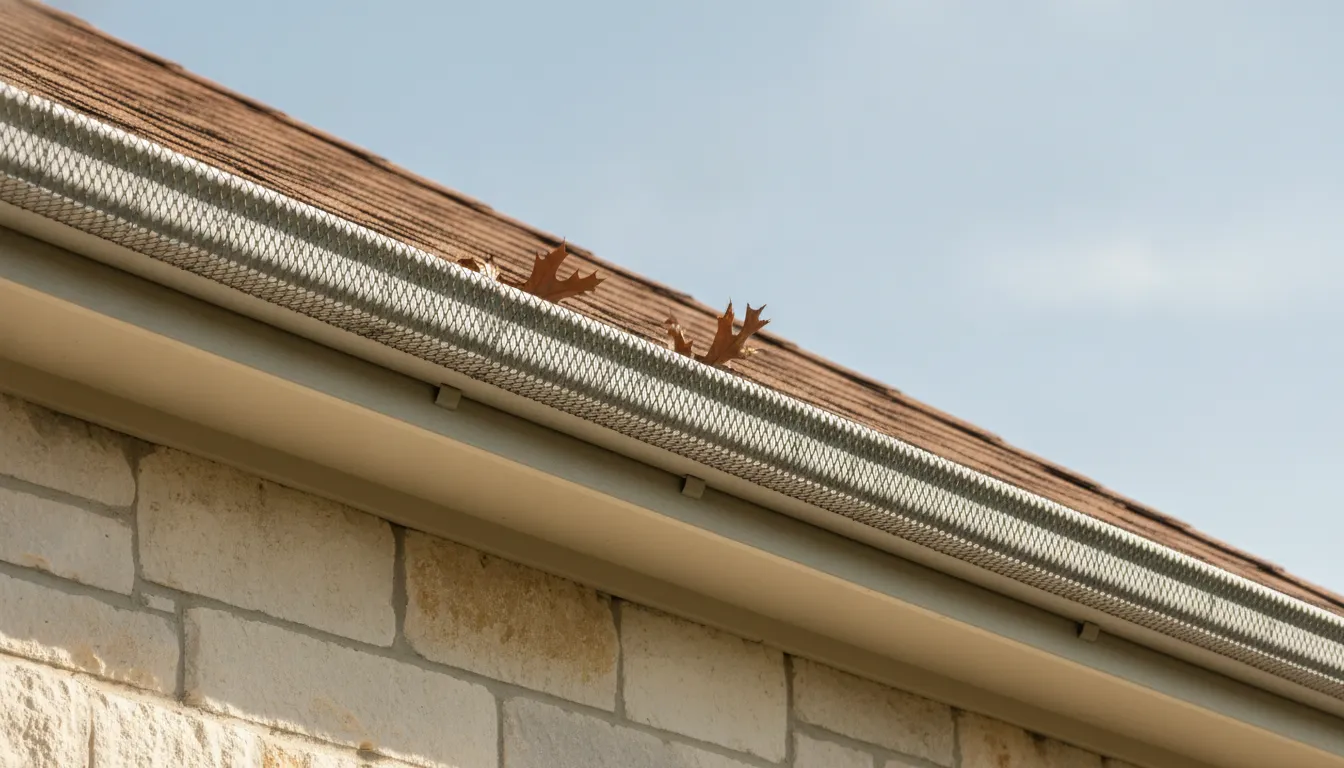
Do gutter guards work when a Central Texas storm dumps water on the roof in a few minutes? They work if water can cross the cover, enter the trough, and leave through a clear downspout. They fail when any one of those three steps stalls. A guard keeps leaves and bulky debris out of the channel. It does not make the gutter larger. It also does not fix a downspout that is already packed.
Request a free estimate or call 512-988-3110 to compare gutter guard options for your home.
TX Gutter Solutions is a family-owned, veteran-led company based in Leander. The crew installs seamless gutters, leaf protection, cleaning, and drainage for homes in Austin, San Antonio, and Dallas-Fort Worth. On the services page, leaf protection is described as durable guards that keep out leaves, pests, and debris so clogs are less likely. That is the claim this page tests against a hard rain, not against a product brochure.
Do Gutter Guards Work When the Rain Comes All at Once?
In a slow rain, almost any cover lets water through. The test in this region is a short, intense storm. The National Weather Service notes that during a flood, water levels and the rate the water is flowing can change quickly. The same thing happens on a roof. A valley can send a whole plane of water onto a few feet of gutter before the guard has cleared the last burst.
Think of the path as three gates. Water has to cross the guard. It has to move along the trough. It has to drop through the outlet and away from the slab. If you watch one storm and see where the spill starts, you usually know which gate failed. Spill along the whole eave, with debris sitting on the cover, points at the guard surface rather than at the gutter itself. Spill at one low corner, with a bare guard, points at the trough or the outlet.
A guard that passed January can still fail in April. Oak pollen lays a film on the mesh that a dry week will not show. The first hard rain then sheets over the front lip instead of dropping through. That is a surface problem, and it is the most common reason people decide guards "do not work" after a single hard storm.
None of this is a buying argument. The page on whether gutter guards are worth it already covers cost, benefits, and which homes should get them. Stay here for the storm test: where the water stopped.
Where Water Stalls in a Downpour
Match the spill you see to the row below. The point is to separate a dirty cover from a gutter that cannot carry the storm, so the next step is the right one for that house.
| What you see. | Where water stalled. | What it usually means. |
|---|---|---|
| Water sheets over a cover coated in pollen, seeds, or a leaf mat. | On top of the guard. | The openings are blinded. The trough may still be empty. |
| The guard looks clear, and one corner pours over the lip. | Inside the trough or at the outlet. | Grit passed the guard, or the gutter has lost its slope. |
| The gutter holds water, and the downspout barely drips. | In the downspout. | The outlet or the elbow is packed. The guard is not the cause. |
| Every outlet runs hard, and water still tops the back of the gutter. | Past the guard, in capacity. | The roof is sending more water than the gutter and outlets can move. |
The first row is the one a hose can sometimes answer on a first story. If a gentle rinse from the roof side lets the next burst of water through, the guard was blinded by debris, not broken. Do not pressure-wash the mesh. That drives grit into the trough and is how a surface problem becomes an outlet problem.
The second and third rows need someone who can see inside. Pulling a fastened panel off a ladder to "just check" is how guards get bent and gaps get left at the corner. If the cover is clear and the outlet is lazy, stop and leave the panels fastened. That visit is a cleaning or a repair, not a verdict on guards.
The fourth row is the one homeowners misread most often. A clean guard on an undersized gutter will still overflow in a Central Texas cloudburst. Seamless gutters on this company's services page are typically $5 to $10 per linear foot, and the price varies by project. That figure is for the gutter, not for a guard. If the storm test says capacity, the conversation is about gutter size and outlets, not about adding another layer on top.
What to Watch During the Next Storm
You can learn most of this from the yard. Do it in daylight if you can, and do not stand in water that is moving toward a sidewalk or a drop.
- Before the rain, note which eaves sit under oaks, pecans, or a roof valley.
- During the burst, watch whether water enters the guard or rides over the front lip.
- Check each downspout. A steady stream is a pass. A drip while the gutter is full is a fail.
- Look at the beds and the slab edge. New mulch trails or a fresh trench mean water left the system in the wrong place.
- Afterward, look for a new fascia stain. One splash can happen in any violent storm and does not mean the system failed. A streak that grows is repeat overflow.
- Write one line: surface, outlet, or capacity. That line is the whole diagnosis.
Valleys deserve the first look. Two roof planes dump into a few feet of gutter, so that spot blinds first even when the long eaves look fine. Older homes in San Antonio and East Austin often have an addition tied into the main roof at an awkward joint. Check that joint. A guard can work on the front elevation and still sheet over where the roofs meet.
Two-story eaves follow the same test without a ladder. Overflow, stains, and the downspout stream are visible from the ground. If those fail on a second story, the next step is a crew, not a climb. The same is true on tile. Walking a tile roof to poke at a guard cracks tiles.
When the Guard Is Doing Its Job
A passing storm looks ordinary, which is why people miss it. Water darkens the guard and then disappears into the trough instead of sheeting over the lip. Downspouts run steadily. The fascia stays the color it was last month. The soil at the outlets looks ruffled, not trenched. If that is your house, the guards are working, and the storm did not reveal a project.
Light debris afterward is normal. A few oak leaves resting on the mesh, like the ones in the photo above, are not a failure. Brush them off a first story if you can reach them without forcing them through the holes. Leave second-story litter for a scheduled visit. The method, by guard style, is in the guide to cleaning gutters that already have guards. This page does not repeat those steps.
How often to do that upkeep is its own question, and so is the schedule for an open gutter with no guard at all. Use how often gutters should be cleaned for the open-gutter rhythm. Do not copy it onto a house that already has covers. Guards are supposed to lengthen the gap between visits, not recreate it.
When a Storm Means the Guard Is Not the Problem
Some overflows clear the guard of blame. If the cover is open and a corner still dumps water every strong rain, look at slope, hanger spacing, and the outlet. A gutter that has pulled away from the fascia will miss water no matter what sits on top. Fascia stains that keep spreading are the clue. They mean the wood behind the gutter is getting wet, which calls for a repair before any decision about the cover.
Pine needles are the other exception. They pass openings that stop ordinary leaves, then mat where you cannot see them. A downspout that underperforms on a house under pines is not a rain-capacity story. The comparison of guards that face pine needles explains the opening-size issue. Read that before you blame the storm.
Hail and straight-line wind create a third case. A dented panel, a lifted end, or a gap at a corner gives water a path around the guard. The system did not "fail to work." It was damaged. Water will use the new gap on every storm until the panel is reseated. That is repair, and it is separate from the question of whether an intact guard handles rain.
Call, or book a free estimate, when any of these show up:
- The same corner overflows in more than one storm after the cover looks clear.
- A downspout drips while the gutter above it is holding water.
- Fascia stains are spreading, or a section of gutter has sagged.
- Wind or hail left a lifted panel, a gap, or exposed fasteners.
- The trouble spot is a second story, a steep pitch, or over tile.
- You would have to unfasten the guard to see the cause.
The limited warranty on the services page covers materials and workmanship for the work TX Gutter Solutions installs. It is not a promise that a guard will stop every overflow, and it is not a maintenance plan. A free, no-obligation estimate is the right ask when the storm test points at the gutter or the outlet rather than at dirt on the cover.
How Roof Layout Changes the Answer
The same guard can pass on one house and spill on the house next door. Layout is why.
A simple hip roof with several downspouts spreads water out. Guards there mostly have to beat pollen and leaves, and they usually do. A long rear elevation, common on newer DFW houses, sends a large roof onto one or two outlets. In a hard rain the guard can be spotless and the gutter can still top out. That result means the outlets or the gutter size are the limit. It is not evidence that guards are a gimmick.
Low-slope porches and screened additions move water slowly, so debris stalls at the tie-in. Check that joint during the storm, not only the street-facing eave. Homes around Cedar Park, Leander, Round Rock, and Georgetown often mix a main two-story roof with a lower porch. Judge each run on its own.
If the storm notes say the guard is clear and the house still overflows, the next pages are local service, not another product roundup. Start with Austin gutter service, San Antonio gutter service, or DFW gutter service, depending on the house. The service area list covers the suburbs around those metros. Style comparisons, if you are still choosing a cover, live on choosing a leaf guard. Use that page for the type decision. Use this one for the rain test after a cover is already up, or while you are deciding whether rain performance is even your issue.
What to Bring to an Estimate
A useful visit starts with the one-line diagnosis from the storm, plus two or three photos. Shoot the corner that overflows, the downspout while it is running or just after, and any fascia stain. Dates help. Three photos of the same spot in May, August, and November tell a crew whether this is pollen, a sag, or a buried outlet.
Say which trees overhang the eave, and whether the bad spot is a valley, a porch tie-in, or a long open run. Mention if the house is one story or two. That is enough for TX Gutter Solutions to tell you whether you need the cover cleaned, the gutter repaired, a larger outlet path, or no work at all.
Do not arrive expecting a yes or no on guards in general. The honest answer is whichever gate failed on your particular roof. If water never got through a matted cover, the guard needs cleaning and maybe a different opening. If water got through and still missed the downspout, the guard was doing its job and something downstream was not keeping up.
If the last storm left a corner overflowing, request a free estimate or call 512-988-3110. A family-owned, veteran-led crew can walk the roofline and tell you which gate failed.
Frequently Asked Questions
Do gutter guards work in heavy rain?
They work when water can cross the cover, travel the trough, and leave through the downspout. A hard, short storm is the real test. If water sheets over a dirty cover, the openings are blinded. If the cover is clear and a corner still overflows, the gutter, the slope, or the outlet is the limit, not the guard.
Why do my gutter guards overflow only in big storms?
Light rain hides a tight spot. A downpour exposes it. Pollen film, a leaf mat at a valley, a packed outlet, or a gutter that is too small for the roof can all stay quiet until the rain rate jumps. Watch one storm and note whether the spill starts on the cover or at a corner.
Can gutter guards handle oak pollen and leaves in Texas?
They handle bulky leaves better than a fine pollen film. Leaves sit on top, where you can see them. Pollen can seal a mesh so the next hard rain rides over the lip. A first-story rinse before storm season prevents that. It is not a sign the guard cannot work.
Should I remove the guards to see if they are the problem?
Not from a ladder, and not as a first step. Check the downspout and the fascia from the ground. If the cover looks clear and the outlet will not run, a crew can open one section, flush it, and refasten it. Pulling panels loose and leaving a gap creates a new leak.
Do gutter guards replace a working downspout?
No. The guard only covers the trough. Water still has to reach an outlet and discharge away from the foundation. A guard on a clogged or undersized downspout will overflow in a strong storm even when the mesh is clean. Fix the outlet path before you judge the cover.