
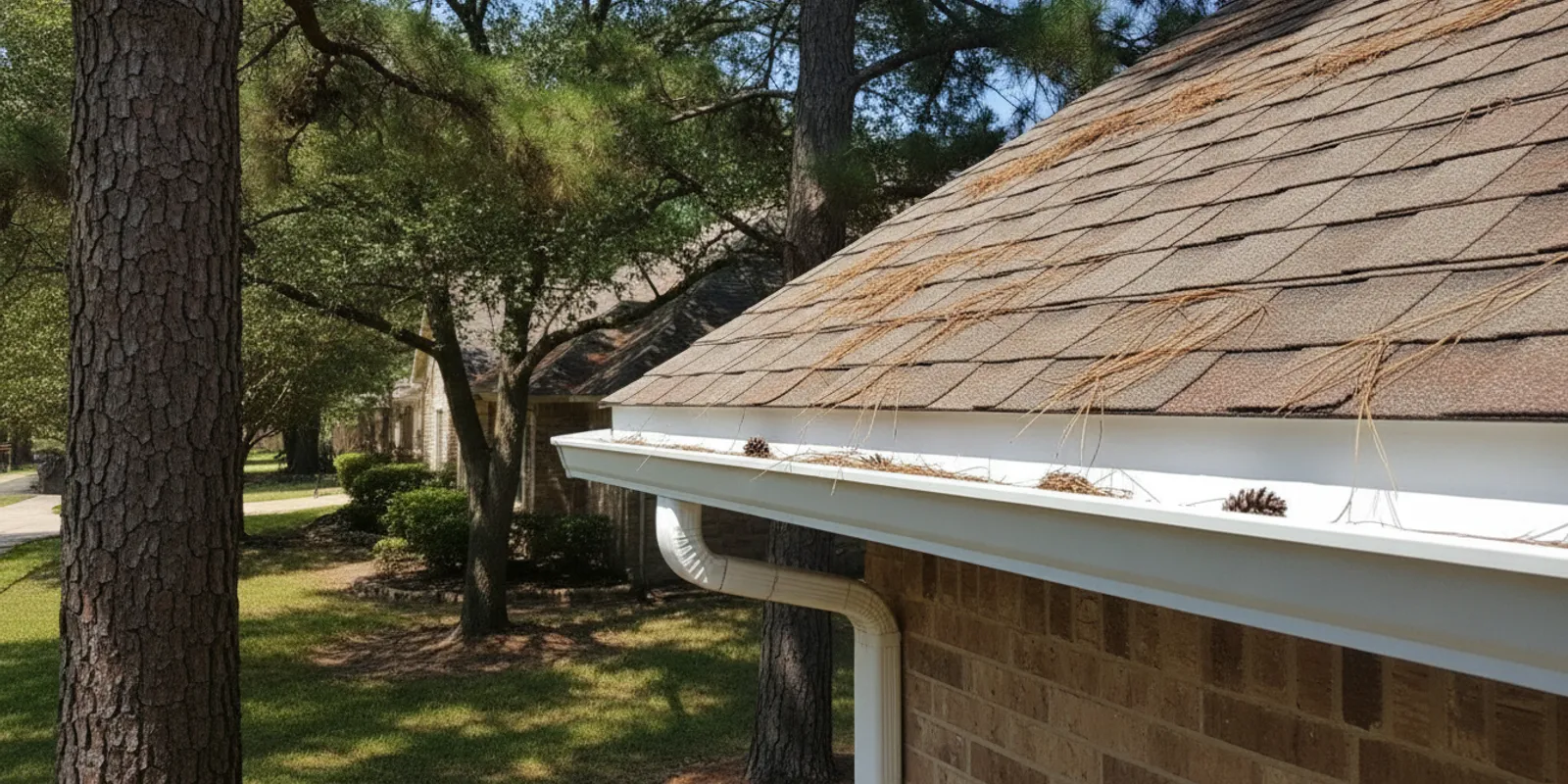
Choosing the best gutter guards for pine needles is less about finding a product that promises to stop every needle and more about matching the guard to the roof, trees, gutters, and maintenance routine at your home. Pine needles are long, narrow, and persistent: they can lie across openings, collect at seams, or reach the gutter with other roof debris. A useful choice starts with understanding where the needles land and how water is supposed to leave the roof.
Request a free gutter estimate
Why are pine needles a challenge for gutters?
Pine needles behave differently from broad leaves. A broad leaf may sit across a larger opening or blow away as it dries. A slender needle can pass through a gap, lie lengthwise along a slot, or become part of a mat when needles, seed material, roof grit, and twigs accumulate together. Wind direction, roof pitch, tree height, and the shape of the roof edge all affect what reaches a gutter.
The problem is not limited to the visible gutter trough. Needles can gather in valleys, behind a chimney, around roof-to-wall intersections, and at the point where a roof section changes direction. When rain washes that debris downhill, it may reach one short stretch of gutter in a much greater volume than other stretches. A guard that looks suitable on a straight run may need careful detailing at corners, valleys, end caps, and downspout openings.
It also helps to separate two goals. A guard can reduce the amount of debris entering a gutter, but no design makes a roofline maintenance-free. Fine debris can sit on top, needles can lodge at an edge, and the outlet or downspout can still become restricted. The question is whether a proposed system manages the debris that actually reaches your roof while keeping water moving into and through the gutter.
What should you inspect before choosing a guard?
Start from the ground, then inspect closer only from a safe location. Note the trees that overhang the roof or stand close enough for needles to blow onto it. Look for roof valleys, dormers, additions, inside corners, and sections where several roof planes send water to the same run. These areas often deserve more attention than a long, unobstructed stretch of eave.
- Tree exposure: Identify which sides of the home receive needles and whether the branches extend over the roof. Note any low branches that drop debris directly into a valley.
- Roof shape: Mark valleys, steep transitions, intersecting roof sections, and places where water concentrates. Record whether the gutter sits under an open eave or is tucked close to shingles or fascia.
- Existing gutter condition: Check for visible sagging, loose sections, separated joints, corrosion, or a gutter that holds water. A cover does not correct a gutter alignment or attachment problem.
- Downspout locations: Notice where each outlet is and where the water goes after it leaves the downspout. Confirm that the outlet is accessible for inspection and clearing.
- Signs of overflow: After rain, if it is safe to observe from the ground, look for water spilling over one section, stains on fascia, or washout below an outlet. These are clues for an assessment, not proof that a guard alone will solve the issue.
- Access and upkeep: Think about how the roofline can be inspected and cleaned. The shape and height of the home can affect which maintenance approach is practical.
Do not climb onto a roof or lean a ladder against a gutter to make this inspection. A ground-level record, photos taken from a safe place, and notes about where runoff appears can give an installer a useful starting point. For a broader review of what to look for, see this gutter inspection checklist.
Which guard styles should you compare for pine needles?
Products are sold under many names, but the functional differences usually come down to the size and shape of the opening, the surface the debris rests on, and how the guard attaches to the gutter or roof edge. The table below is a starting point, not a promise that a style will work on every roof. Product design and installation details vary, so compare the actual assembly being proposed.
| Guard style | How it handles debris | Potential fit for pine needles | What to verify |
|---|---|---|---|
| Open screen or perforated cover | Uses visible holes or slots to let water through while holding back larger debris. | Needles may bridge openings, pass through larger gaps, or collect on top, depending on the opening pattern. | Opening dimensions, edge coverage, attachment, and how the surface can be cleared. |
| Fine mesh or micro-mesh | Uses a finer surface to limit the passage of smaller debris while admitting water. | Can be worth comparing where narrow needles and fine roof debris are concerns; debris can still sit on the mesh or block it. | Mesh material and support, cleaning access, roof-edge fit, and how water reaches the surface. |
| Solid or curved-surface cover | Guides water over a shaped edge while debris is intended to continue past the gutter. | Needles may collect at the nose or edge rather than enter the trough; performance depends on water flow and fit. | Compatibility with the roof and gutter, how concentrated runoff enters, and cleaning method. |
| Foam or brush insert | Sits within the gutter and allows water to pass through or around a porous or bristled insert. | Needles can settle in the material or become entangled, so inspectability and removal matter. | How easily it lifts out, whether the outlet stays accessible, and what routine care is recommended. |
| No cover, with planned cleaning | Keeps the gutter open and relies on inspection and removal of debris. | May be a reasonable comparison when a guard is difficult to fit or the home can be maintained safely. | How often debris accumulates, safe access, gutter condition, and downspout clearing. |
Do not compare only the product label or a photograph of a sample. Ask to see how the proposed guard fits the actual gutter profile and roof edge. A fine opening, for example, is only one part of the system. If water runs over the guard, if debris builds at an exposed edge, or if the outlet is difficult to reach, the details may matter more than the name of the material.
How does the right approach change with the roof layout?
Two homes with similar pine trees may need different recommendations because their rooflines send needles and water in different directions. Use the following examples to see why a site-specific inspection matters. They are common patterns to discuss, not fixed rules for every property.
A long, open eave beneath nearby pines
On a simple roof edge, needles may arrive across a broad area instead of gathering at one point. Ask which guard surface will let water enter while limiting debris from reaching the trough, and how needles will be cleared from the top. The provider should explain how the system attaches along the run and how its ends are finished. Also ask what happens where the run meets a downspout. A long, straight section may be straightforward to cover, but the outlet still needs to remain accessible.
A roof valley that sends runoff to one corner
When two roof planes meet, the valley may channel water, needles, and fine debris toward a short gutter section. In this setting, do not judge a proposal only by the guard's mesh or opening. Ask how water flows at the valley during a strong rain, whether debris can accumulate at that point, and what detail prevents runoff from bypassing the gutter. The estimate should call out that location and explain how the corner and outlet will be inspected later. If the issue is concentrated flow, the conversation may need to include the gutter and outlet arrangement as well as the cover.
A mixed roof with additions or several corners
Porches, dormers, and later additions can create short runs, inside corners, and changes in roof height. Needles may collect where these sections meet, while a guard may need to be cut or joined around the transitions. Ask the installer to point out each change in direction and say whether any small area will remain uncovered. Find out if a transition requires a distinct detail or a different approach from the straight runs. A clear plan makes it easier to understand how the system is supposed to work and where to look during future checks.
These examples also show why a recommendation should be based on more than the number of pine trees in the yard. The tree's distance and height, roof design, prevailing exposure, and gutter condition all influence what reaches the eaves. A provider should be able to connect the proposed product to observed conditions and explain what the product will not do.
What should you verify about the product and the work?
Before approving an installation, make sure you understand the actual product and scope rather than relying on a broad label such as screen or mesh. Ask for the product name and written description, including the material, how it is supported, and how it attaches to your particular gutter and roof edge. If several styles are offered, request an explanation of what differs and which roof condition makes one a better fit. You do not need to be an expert in every guard design; you do need a clear account of what will be installed on your home.
Then review the work area by area. The scope should account for corners, end caps, roof valleys, changes in roof pitch, and downspout openings, not just the straight footage along the eaves. Ask whether any existing gutter section must be cleared, reattached, adjusted, or repaired before a cover goes on. If the provider proposes a change to the gutter or outlet, ask how that change addresses the condition they observed. For a related look at the outlet itself, this guide to downspout replacement considerations may help you prepare questions.
Agree on how completion will be checked. Ask whether the crew will verify attachment and alignment, review the transitions, and make sure the downspout openings are clear. Find out what documentation or care information you will receive and whom to contact if you notice water spilling or debris gathering. These are practical scope questions; they do not require a guarantee that weather or debris will never create a maintenance issue.
Finally, compare explanations in the same order: observed problem, proposed response, limitations, installation details, and ongoing care. One recommendation may emphasize keeping fine material out of the trough; another may focus on surface clearing or access. Decide based on how well the explanation fits your roof and how workable the maintenance plan is, not on a claim that one product is universally best.
Does a finer opening always work better?
Not by itself. Finer openings can reduce the amount of small debris that enters the trough, but the surface still has to admit water and remain serviceable. Pine needles, pollen, roof grit, and other fine material can gather on top of a guard. If the roof sheds a concentrated stream at a valley, that flow may behave differently from water along an ordinary eave.
Ask how the chosen surface responds to the specific debris pattern on your roof. A sample can help you understand construction, but it cannot reproduce every roof pitch, edge detail, or runoff path. The installer should explain how the guard meets the fascia or roof edge, how corners and valleys are treated, and what to do if a surface layer forms.
Also consider whether you can inspect the cover. Some assemblies are easier to lift or service than others. A design that limits debris entering the gutter but makes the gutter and outlet hard to inspect may not suit a homeowner who wants straightforward upkeep. It is reasonable to ask what maintenance remains after installation and who can perform it safely.
How do roof valleys and concentrated runoff change the choice?
Valleys collect water from adjoining roof planes and direct it toward a smaller part of the eave. If a valley discharges near a gutter corner, the area can receive more water and debris than a standard section. An installer should look at the valley's location, the direction of flow, and any nearby guard edges before recommending a cover.
Look for these details during an estimate conversation:
- Does the valley discharge onto a guard, directly into the gutter, or beyond the gutter edge?
- Is there a valley splash guard or other detail, and how does it interact with the proposed gutter cover?
- Could pine needles pile up at the valley outlet or at the end of a short gutter run?
- Are inside and outside corners accessible for cleaning?
- Does the gutter and downspout route handle the water arriving at that location?
A visible overflow spot may have more than one cause. Debris on a guard is one possibility; gutter slope, a blocked outlet, an undersized or poorly placed downspout, or a roof-flow concentration may also deserve attention. Ask for the cause to be explained rather than assuming that adding a cover addresses every symptom.
What makes installation fit as important as the material?
A suitable product can underperform if it is cut, supported, or attached poorly. The guard needs to align with the gutter and roof edge as intended, remain stable, and avoid creating a path that sends water behind the gutter. Transitions matter: end caps, corners, roof valleys, downspout openings, and changes in gutter direction should be part of the plan rather than treated as afterthoughts.
Ask whether existing gutter problems will be corrected before or during installation. A loose or sagging run, a damaged fascia edge, or a gutter that does not drain as intended can affect the result. It is not useful to cover over a condition that should first be inspected and addressed. If the gutter system itself needs work, review the company's gutter installation, repair, and cleaning services to understand the relevant service options.
Confirm how the installer will handle sections that are difficult to reach, such as a high roofline, an enclosed porch, or a transition between different roof planes. Ask whether any portion of the gutter remains uncovered, where debris may collect, and how the completed work will be checked. Clear answers should relate to your home's details, not just a general statement that a product suits every roof.
What questions help you compare recommendations?
Use the same questions with each provider so you can compare the reasoning, not just the product descriptions. A careful recommendation should explain the roof and gutter conditions observed, the limitations of the proposed guard, and the maintenance that remains.
- Which parts of my roof are the main needle-entry points? Ask the installer to identify exposed eaves, valleys, corners, and any problem sections during the inspection.
- How does this design handle long pine needles? Request an explanation of whether needles may pass through, rest on top, or gather at edges and transitions.
- How will concentrated water enter the gutter? Discuss roof valleys and any section where water arrives in a focused stream.
- What happens at the corners and downspout openings? Ask how each transition is fitted and how the outlets can be inspected and cleared.
- Does anything about my existing gutter need attention first? Ask about slope, attachment, visible damage, and drainage before approving a cover.
- What upkeep should I plan after installation? Ask what to check, how to clear debris safely, and whether the guard can be lifted for service.
- How will the finished work be reviewed? Ask what the crew checks at the seams, edges, outlets, and other complicated areas.
For help evaluating a contractor's explanation and proposal, use this guide to choosing a gutter contractor. The goal is not to find a promise that no debris will ever collect. It is to understand the work, limits, and follow-up before deciding.
How can you check whether a guard is working?
Plan a simple observation routine after installation. First, keep the work description and any care instructions where you can find them. Note the location of valleys, outlets, and the roof edges most exposed to pine trees. After a period of needle fall or a significant rain, inspect from the ground when conditions are safe. Look for visible accumulation on top of the guard, water spilling at a particular section, or debris gathering around a downspout opening.
Do not treat a single dry-day observation as proof that the system is clear. Water behavior is most useful to observe during or just after rain, but never inspect from a ladder or roof in wet or windy conditions. Keep away from electrical lines and unstable ground. If you cannot see the roof edge safely, arrange for a qualified person to check it.
When you see a concern, record the exact location and what happened. For example, note whether overflow came from the middle of a straight run, below a roof valley, or near an outlet. This helps distinguish a localized debris issue from a broader drainage or installation question. A photo taken safely from the ground can also help an installer understand what you observed.
What maintenance still matters with pine trees nearby?
Guards change where debris collects; they do not remove the need to check the roof drainage path. Needles can rest on the guard, gather in valleys, lodge around a corner, or mix with other material at the outlet. A maintenance plan should reflect tree exposure and roof layout rather than rely on a fixed schedule that ignores what is happening at the home.
- Keep a seasonal log: Record when needles begin to accumulate and which sides of the house are affected. Over time, this can help you schedule inspections around your own tree and roof conditions.
- Check after wind and heavy debris fall: Look for fallen branches and accumulations from a safe vantage point. Do not remove a large branch or attempt roof work yourself.
- Watch the discharge point: Confirm that water leaving the downspout has a clear route away from the outlet. If water pools close to the home, investigate the full drainage path rather than focusing only on the guard.
- Keep outlets serviceable: Ask how the downspout opening can be checked and cleared without damaging the guard.
- Use safe access: Hire a qualified professional when roof height, pitch, or access makes inspection unsafe.
- Revisit the plan when conditions change: New branches, roof work, an addition, or a changed runoff path can alter the debris pattern.
Homeowners who prefer a professional check can learn more about why routine gutter cleaning matters. A guard may reduce how much material enters the trough, but cleaning or inspection needs depend on the actual roof and system. Avoid assuming that a covered gutter no longer needs attention.
When might a guard not be the first step?
If a gutter is pulling away, holding standing water, or spilling at a particular corner, first identify the cause. Adding a guard before correcting a drainage or attachment issue can make later inspection harder without solving the original problem. Similarly, if water runs behind the gutter or the fascia shows signs of moisture exposure, ask for that condition to be evaluated before choosing a cover.
Sometimes the right first move is to clear the existing gutter and observe its flow. In other cases, the issue may involve a downspout route, a roof valley, or where the runoff is discharged at ground level. TX Gutter Solutions also discusses broader yard drainage options; that can help frame questions when water remains near the home after it leaves the roof system.
Keep the decisions in the right order: find the source of the problem, confirm that the gutter and outlets function, then compare guard options for the remaining debris concern. If the inspection reveals that a repair or a different drainage adjustment is needed, a guard recommendation should explain how those steps fit together.
How do you choose the best option for your home?
Use a short decision sequence rather than selecting by a single product feature:
- Map the needle pattern. Identify overhanging pines, valleys, corners, and the gutter sections that receive the most debris.
- Check the existing system. Confirm that the gutters are attached, reasonably clear, and able to drain toward accessible outlets.
- Compare designs against the debris. Consider opening size, surface, edge detail, and how the guard handles long needles mixed with fine roof debris.
- Review the tricky sections. Ask how the installer will treat valleys, corners, ends, and downspout openings, and how those areas can be maintained.
- Make upkeep part of the decision. Choose a system whose inspection and cleaning needs are realistic for your home and your access constraints.
- Confirm the full scope. Get a clear explanation of what will be installed, what existing issues need attention, and what maintenance remains.
A good answer may differ from one house to another, even on the same street. One home may have a simple roof edge and scattered needles; another may have several valleys that direct debris and water toward a small number of gutter sections. The strongest recommendation explains those differences and sets realistic expectations about both water flow and upkeep.
How can you organize a fair comparison?
After each inspection, write down the same details while they are fresh. This makes it easier to see whether two recommendations respond to the same conditions or whether one provider has noticed a roof feature the other did not discuss. Keep the notes focused on your home rather than on generic product claims.
- Observed exposure: Which roof edges sit beneath or near pine trees? Where do needles appear most often?
- Water path: Which roof planes feed each gutter run, and are any valleys directing runoff to one spot?
- Current condition: Were gutter attachment, alignment, end caps, and downspout openings reviewed? What, if anything, needs attention first?
- Proposed guard: What product and attachment method are included? Which parts of the roof will receive it, and are any areas treated differently?
- Transitions: How will the proposal handle corners, valleys, gutter ends, and outlets?
- Care plan: What should be inspected after debris fall or rain, and what method is safe for your roofline?
Notice how each provider handles uncertainty. A responsible answer can explain what is known, what still needs inspection, and what limitations remain. Be cautious of an explanation that skips the roof layout, treats every guard as identical, or suggests that installing a cover will automatically correct an existing overflow. Ask for the reasoning in plain language and request that important details be reflected in the written scope.
It is also useful to separate the product decision from the maintenance decision. Ask what the guard is intended to keep out, what might remain on the surface, and what could still enter through an opening or outlet. Then consider whether someone can inspect and maintain those parts safely. A system that suits the debris pattern but is difficult to reach may call for a professional maintenance plan rather than a do-it-yourself routine.
Finally, check that the proposal leaves you with a clear next step if you later see water spilling or needles gathering. You should know which location to report, what observations are useful, and whether the issue calls for cleaning, adjustment, or a closer review of the drainage path. Clear expectations help you evaluate performance without assuming that every visible needle means the guard has failed.
Talk through your gutter guard options
Frequently asked questions
Can gutter guards keep every pine needle out?
No guard should be assumed to block every needle in every condition. Needles can collect on the surface, pass through openings, or gather at edges and transitions. Compare how the proposed design handles your roof's debris pattern and ask what maintenance will still be needed.
Are micro-mesh guards automatically the best for pine needles?
Not automatically. A fine mesh may be one option to compare, but its fit, support, edge details, response to concentrated runoff, and cleaning access also matter. Ask the installer to explain how the actual product and installation suit your roof rather than relying on the category name alone.
Do gutter guards eliminate gutter cleaning?
No. They can change how much debris enters the trough, but needles and fine material may collect on top or around openings, and downspouts still need to be checked. Follow the product's care guidance and arrange safe inspection when you cannot see or reach the roofline.
Should I install guards if my gutters already overflow?
First find out why they overflow. Debris may be involved, but gutter condition, outlet blockage, roof-valley flow, or the route after the downspout may also need attention. Ask for the underlying cause to be assessed before deciding whether a guard is part of the solution.
What should I bring to an estimate appointment?
Bring notes about which trees overhang the roof, where needles accumulate, and where you have observed overflow or standing water. Photos taken safely from the ground can help. Ask the installer to review the roof shape, gutter condition, corners, valleys, and downspout access before recommending a system.
Schedule a no-obligation gutter consultation
The best choice for a pine-needle-covered roof is the one that fits its runoff paths, can be installed and inspected properly, and comes with a maintenance plan you can follow.