
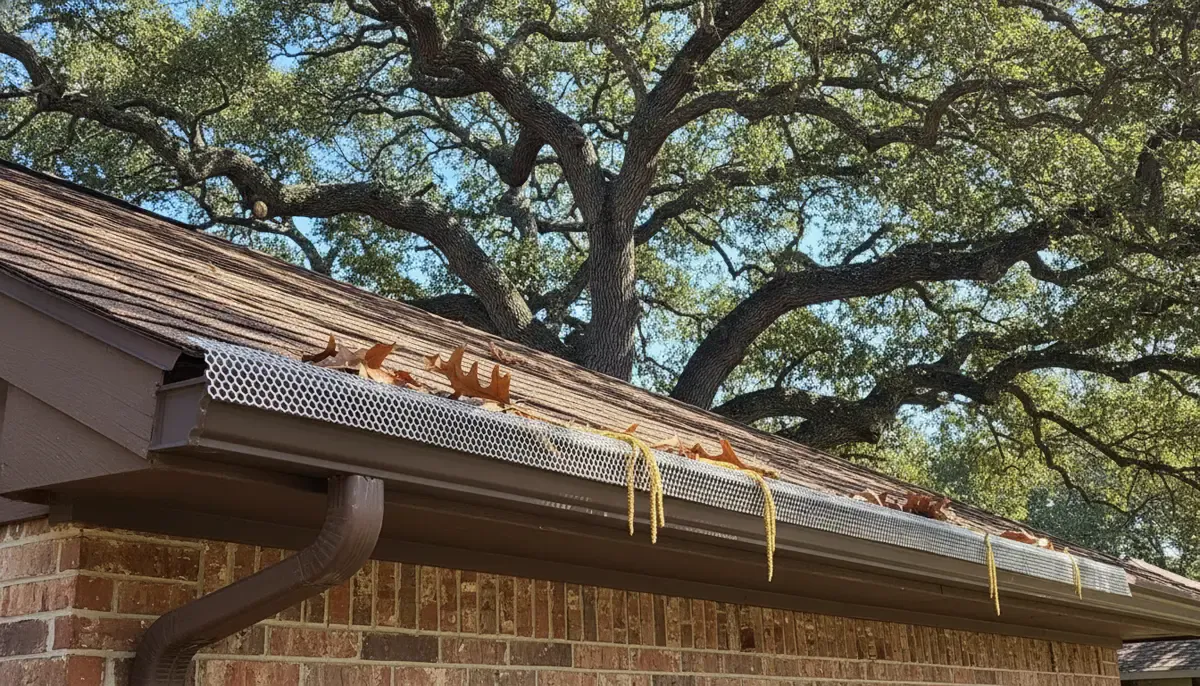
Live oaks do not wait for fall. Across Austin, San Antonio, and the Dallas-Fort Worth area, they drop old leaves and long flower catkins in late winter and spring, right when new growth pushes out. Red oaks add large leaves and acorns later in the year. Micro mesh gutter guards for oak trees are a fine stainless surface meant to keep that mix on top of the gutter instead of inside it.
A coarse screen lets catkins and small leaf bits through. Foam and brush inserts hold that debris in the trough. A fine mesh is the style worth comparing when oaks hang over the roof. It is not a promise that the gutter never needs a look. The mesh still has to match the roof, the slope, and the downspouts.
TX Gutter Solutions is a family-owned, veteran-led company that installs seamless gutters, gutter guards, cleaning, and drainage for Central Texas homes. If oak debris is already stacking on your eaves, start with a free, no-obligation estimate.
leaf protection service or call 512-988-3110.
What Oak Trees Put in Central Texas Gutters
Two oaks show up on most of the roofs we see. Live oak is the evergreen shade tree of Austin, San Antonio, and a lot of Dallas neighborhoods. Texas red oak is the deciduous tree that turns and drops in late fall. They do not clog a gutter the same way, and a guard has to deal with both if both trees are near the house.
Texas A&M Forest Service describes live oak as a large native with thick, leathery leaves about 2 to 4 inches long. Male flowers grow on catkins up to 3 inches. Those catkins are the yellow tassels that coat cars and roof edges in spring. The same profile notes acorns about an inch long.
Texas A&M AgriLife Extension says the spring leaf drop is normal. Live oaks shed old leaves as new buds open, often from late January into February. The tree is not sick just because it looks thin for a few weeks.
That spring drop is the one national "clean in October" advice misses. Old live oak leaves, stringy catkins, and fine pollen land together. Later, red oak leaves are broad enough to mat, and acorns are heavy enough to sit in a trough or roll to a corner. Pecan leaflets and cedar elm seeds often join them. The guard question is which of those pieces the surface can keep out, and which ones will still sit on top.
| Debris | When it shows up | What it does to an open gutter |
|---|---|---|
| Live oak leaves and catkins. | Late winter into spring. | Stringy tassels and small leathery leaves pack the trough and the outlet. |
| Oak pollen film. | Spring, then the first hard rain. | A dry film can make water sheet over a guard instead of dropping through. |
| Red oak leaves. | Late fall. | Large leaves mat and hold water against the metal. |
| Acorns. | Fall. | Hard nuts collect at corners and can block a downspout opening. |
How Micro Mesh Gutter Guards for Oak Trees Handle That Debris
Micro-mesh is a very fine stainless screen on a firm frame, set over the gutter opening. Water is supposed to pass. Leaves, catkins, and acorns are supposed to stay on the roof side or slide off the front edge. For oak cover, that is the point of the fine opening: a wide screen hole is big enough for a catkin tip and a broken live oak leaf.
Live oak leaves are small, stiff, and curved. They do not lie flat the way a maple leaf does. On a fine mesh they tend to rest on top, where wind or a soft rinse can move them. Catkins are worse on a coarse guard. The tassels are thin enough to thread a screen, then tangle inside where you cannot see them until water comes over the front lip.
Acorns are the opposite problem. They are too big to pass a micro-mesh, so they sit on the surface or in the valley. That is a win for the inside of the gutter and a chore for the outside. A few nuts on the mesh are not a failed guard. A pile at a roof valley is a spot to clear so water can still reach the openings.
Pollen is the limit no hole size erases. A dry week can leave a film on the mesh. The first hard rain then rides over the lip instead of dropping in. Brushing a first-story run, without pushing the film through the holes, is normal care. It is not a sign you picked the wrong style.
When a Fine Mesh Fits an Oak Canopy, and When It Does Not
Match the guard to the debris you can see, not to a product name. Use this order on an oak-heavy lot before you treat mesh as the next step.
- Name the trees over each eave. Live oak, red oak, pecan, and cedar elm drop on different calendars.
- Look in the trough. Catkins and grit inside point toward a finer surface. Whole leaves only may be a simpler screen.
- Check slope, outlets, and hangers. A guard cannot fix a gutter that pitches the wrong way or a downspout that is already packed.
- Note valleys and low eaves. Those spots concentrate leaves and acorns even when the rest of the run stays clear.
- Decide what maintenance you will still do. Fine mesh cuts ladder cleanings. It does not end them.
A long, open eave under a live oak is the clearest fit. The mesh keeps the spring mix out of the trough, and the surface is easy to see from the yard. A roof valley that dumps onto one corner needs the same mesh plus a plan for the pile that forms there. Mixed roofs, with an addition or several inside corners, need the guard fastened so those corners do not open a gap.
Skip the guard as the first step when water already pours behind the gutter, the fascia is soft, or a downspout never runs during rain. Those are repair and drainage problems. Our gutter services cover seamless installation, repair, cleaning, and leaf protection, so the visit can start with whatever is actually failing.
We install guards across Austin, San Antonio, and Dallas-Fort Worth. Seamless gutter pricing on the services page is typically $5 to $10 per linear foot and varies by project. Guard pricing is separate and depends on the home, so we do not quote it from a national average.
What to Check on the Gutters Before the Mesh Goes On
A fine screen makes a bad trough quieter until the next storm. Walk the eaves, or have us walk them, and confirm four things.
The gutter should pitch toward the outlet. Standing water in the middle of a run means the hangers or the slope need work before a cover hides the problem. Outlets should be open. One clogged drop on an oak corner will send water over a brand-new mesh. Spike-and-ferrule hangers that have pulled loose will sag under wet leaves even if the mesh is sound.
Fascia behind the gutter should be firm. If the board is soft, fastening a guard to it only hides the rot. Downspouts should discharge away from the foundation. Guards do not move water once it is in the pipe. If the yard holds water at the splash block, that is a drainage conversation, not a mesh conversation.
On older lots the live oak limbs sit close to the shingles. Debris volume there is higher, and so is the chance of small branches on the mesh after wind. The guard still helps, but the estimate should say how those runs will be cleared. A limited warranty on our work covers materials and workmanship. It is not a promise that oak debris will never land on the cover.
How This Differs From a Pine-Needle or All-Purpose Guard
Pine needles and oak debris get lumped together because both are "fine." They are not the same shape. Needles can spear a small opening and stand in the mesh. Live oak catkins tangle. Red oak leaves mat on top. A page about pine needles is about that spear problem. This one is about the oak calendar: spring tassels, then fall leaves and acorns.
An all-purpose comparison of screen, foam, brush, reverse-curve, and micro-mesh is useful when you do not yet know your debris. Once the trees are oaks, the decision narrows. Foam and brush hold wet leaves in the trough. A wide screen lets catkins through. Reverse-curve covers rely on water jumping a nose, and a pollen film or a leaf mat can send that water over the edge. Fine mesh is the surface we compare first for this debris, then we check fit, support, and the roof layout.
If you are choosing a guard for needles, read our pine needle gutter guard guide instead of treating this article as that answer. If the question is whether any guard pays for itself, that is a different decision from which opening size fits an oak.
What You Still Do After the Guards Are On
Plan on looking twice a year, lined up with the trees. Late spring, after live oaks finish shedding, is the first pass. Late fall, after red oaks and pecans drop, is the second. Homes with limbs over the roof may need a look after a windstorm as well.
From the ground, check three things. Water should enter the mesh in a shower, not sheet over the lip. Downspouts should run a steady stream. Corners and valleys should not hold a dam of leaves or acorns. A few dry leaves on the mesh are normal. Do not pressure-wash them through the holes. That pushes grit into the trough you just protected.
If the mesh looks clean and the gutter still overflows, the guard is probably not the cause. Slope, an outlet, or a buried drain is. Our guide to why gutter cleaning matters covers what packed debris does to fascia, siding, and the foundation when a system is left open. Guards reduce how often that happens. They do not retire the downspouts.
Want a second set of eyes on the oak runs before the next pollen week? Tell us which trees sit over the roof. We will say whether mesh belongs on those eaves or whether repair comes first.
A Walkthrough for One Oak Eave
Picture a one-story brick home in Round Rock or Georgetown with a live oak over the back roof and a red oak at the side yard. In March the back eave collects tassels. In November the side eave collects broad leaves and acorns. One guard style can serve both runs, but the inspection notes should not be identical.
On the back eave, look for catkins inside the trough and a yellow film on the shingles just above the gutter. If the inside is packed with tassels, a coarse cover has already shown it will not hold them out. A fine mesh is the comparison to make, after you confirm the outlet is open. On the side eave, look for leaf mats and nuts at the corner. The mesh keeps those nuts out of the pipe. You still need a way to sweep the corner from a stable ladder or from the ground with a soft brush.
Bring three photos to the estimate if you can. One of the trees over the roof, one inside the gutter at the worst corner, and one of the downspout during or just after rain. Those three tell us whether the oak debris is the problem or whether the gutter is pitched away from the outlet. We would rather fix the pitch first than cover it.
The same walk applies in San Antonio yards where live oaks are older and lower, and on Dallas-Fort Worth lots where red oaks and cedar elms share the fence line. The debris calendar shifts a little with the first cold front. The decision does not. Name the tree, name the piece that is getting in, and only then choose the opening size.
Frequently Asked Questions
Do micro mesh gutter guards stop live oak catkins?
A fine mesh stops most catkins from entering the trough. The tassels sit on top or hang off the edge. You may still brush them off after the spring drop so the next rain can pass through.
Will oak acorns clog a micro-mesh guard?
Acorns are too large to pass the mesh, so they do not fill the gutter. They can pile on the surface at a valley or corner. Clear those piles so water can reach the openings.
Do gutter guards end cleaning under oak trees?
No. They cut how much debris gets inside and how often you need a full cleanout. Plan a look in late spring and late fall, plus after storms if limbs hang over the roof.
Can I add mesh if my gutters already overflow in the first rain?
Not as the first fix. Overflow with a clean trough usually means slope, hanger, or downspout trouble. Repair that, then add the guard so the new cover is not hiding the leak.
Which phone number should I use for an oak-guard estimate?
Call 512-988-3110 for Austin and the main line. San Antonio homes can call 210-716-7750, and Dallas-Fort Worth homes can call 682-259-4438. You can also send the form on the contact page.